






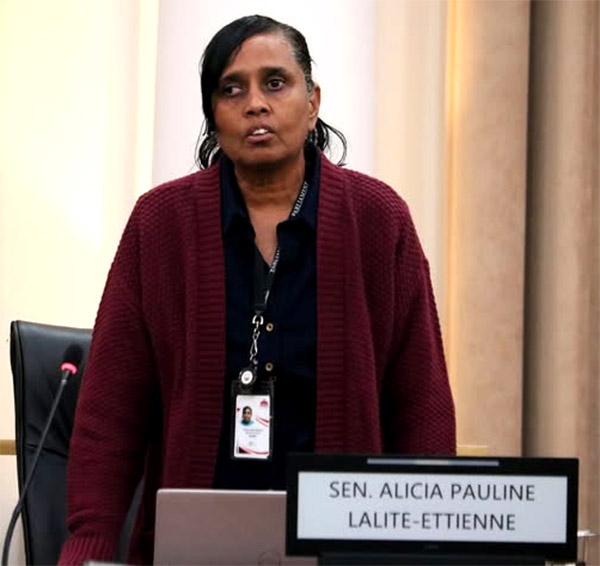
There are moments in Parliament when the mask slips, when procedure gives way to something far more revealing. Senator Alicia Lalite-Ettienne’s closing remarks were one such moment last Tuesday. Not because of what she said alone, but because of what her words and her visible distress exposed about the culture of governance we are tolerating.
This was not just another contribution in a long debate. It was a final appeal, grounded not in abstraction but in lived experience. A blind Senator, piloting legislation designed to improve the lives of persons with disabilities, rose to close her case.
What followed was not theatre. It was reality breaking through the sterile walls of parliamentary protocol, and it was uncomfortable as it should have been.
What her closing remarks laid bare is that in Trinidad and Tobago, we have become dangerously adept at discussing human vulnerability as if it were a technical inconvenience. We dissect, we critique, we score points, but somewhere in that process, we forget the people at the centre of it all.
Her voice did not falter because she was unprepared. It faltered because she was carrying more than a bill. She was carrying a truth that the Government seemed unwilling or unable to fully confront: that disability in this country is still treated as an afterthought, and those advocating for change must fight not only for policy but for basic recognition, and that is where the Government must be held to account.
No administration is obligated to support every piece of legislation. That is not the issue. The issue is how it chooses to engage. When a Senator, particularly one representing a historically marginalised group, reaches the point of emotional collapse in her closing, the problem is not simply disagreement; it is the environment that made that collapse possible.
That environment, by all appearances, was one of force rather than sensitivity, of rebuttal without restraint, of engagement that prioritised dominance over understanding. This is not strength. It is a failure of leadership.
Leadership requires discipline, not just of policy, but of tone. It demands the ability to recognise when an issue transcends politics and enters the realm of human dignity. It requires the wisdom to understand that some debates are not battles to be won, but responsibilities to be handled with care. Yesterday, that wisdom was absent, and the consequences extended beyond one Senator.
Because every person with a disability watching that exchange in Parliament saw something. They saw how their advocate was treated. They saw how their issues were received. And they concluded, not from press releases or political spin, but from what unfolded in real time.
The message, whether intended or not, was deeply troubling: that even at the highest level of representation, even with the floor, even with the law on your side, you may still have to fight to be heard, not just politically, but humanely. That is not the mark of a progressive society. It is the mark of one who is stagnating.
What makes this moment particularly damning is that it was entirely avoidable. The Government could have disagreed, firmly, even forcefully, while maintaining respect. It could have challenged the bill without undermining the person presenting it.
It could have demonstrated that governance is not merely about control but about stewardship. Instead, it allowed the debate to descend into something that left a Senator in tears, and that image will linger, not because emotion is unusual, but because of what caused it.
We must now ask ourselves a hard question: if this is how we handle issues of disability in Parliament, what does that say about how seriously we take them in practice? Policy is only one part of progress. Culture is the other, and yesterday, our parliamentary culture was found wanting.
Senator Lalite-Ettienne’s closing remarks should not be remembered for the tears. They should be remembered for what they revealed: that empathy, in our highest institution, is not yet guaranteed.
Until that changes, no amount of legislation will be enough.
