





By Hugo Maynard
There are some deaths that do not leave a country quietly.
They linger. They sting. They accuse.
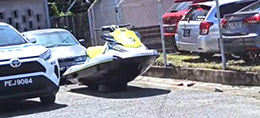
The death of seven-year-old Angelica Sadie Jogie at Pigeon Point is one of those moments. A little girl went into the water with her family and did not come back alive. She was struck by a jet ski inside an area designated for bathers, after, according to reports, the craft broke through the perimeter rope. Her family tried to save her. First responders tried to save her. But by the time the dust, the screams and the horror settled, a young life was gone.
And now the question standing in the middle of Tobago like a judge in black robes is this: how many warnings does authority need before it decides to act like authority?
Chief Secretary Farley Augustine, this is not the time for soft language, sympathetic press conferences and the usual official sorrow that arrives after the blood is already on the ground. This is the time for candour and courage. Tobago must regularise these operators. Properly. Completely. Urgently.
Because this accident did not fall from the sky like rain.
The signs were there long before this child died.
The record shows that Pigeon Point has been shadowed for years by warnings, near-tragedies, actual tragedies, reckless behaviour and institutional drift. As far back as 2007, bathers were reporting vessels speeding dangerously close to people in the water. That same year, two young people were seriously injured after a boat struck them while they were bathing.
Even then, the point was plain: buoys and cordons mean little if they are not enforced, monitored and backed by real discipline. Later reporting showed buoys were installed only after that near-fatal incident, a detail so damning it reads like a national habit: do nothing, wait for calamity, then suddenly discover urgency.
And here we are again.
A child is dead.
A jet ski operator has fled.
A nation now pretending to be shocked by what it was repeatedly warned could happen.

Anybody who has spent real time in Tobago, not the brochure version but the living version, knows exactly what many beach users have known for years. At places like Pigeon Point, some operators move about with an air of impunity, threading through the coast as if the sea were theirs alone to hustle on.
They skim too close. They cut too sharp. They pursue business with the impatience and aggression of a maxi conductor bawling for one more passenger on the Port of Spain route, as if every extra dollar justifies every extra risk.
And what does that do to the ordinary family in the water?
It poisons the whole experience.
You cannot relax when machinery is whining near the rope line. You cannot enjoy Tobago’s waters when the boundary between recreation and catastrophe feels as thin as fishing twine. The sea is supposed to offer release, not roulette.
This is why regularisation is not some bureaucratic technicality. It is not paperwork for paperwork’s sake. It is the difference between order and lawlessness. Between tourism and recklessness dressed up as hustle. Between a protected beach and a floating gamble.
Who is licensed? Who is insured? Who is trained? Who is medically certified? Who is checking sobriety? Who is checking speed limits? Who is verifying routes?
Who is ensuring that no operator comes close to bathing zones?
Who is inspecting the jet skis, the glass-bottom boats, the party boats and the reef-tour vessels to ensure they are seaworthy and not just painted pretty enough to fool a visitor for fifteen minutes?
That is the heart of the matter.
Because this issue does not stop at jet skis. The same concern reaches the glass-bottom boats and the party boats. Reports in the material before us show another party boat sank in Buccoo Reef Marine Park after becoming overloaded, and that it was the second such sinking reported within the same month. Thankfully, there were no deaths in that case. But is Tobago waiting on a mass-casualty event before the full seriousness of this problem is admitted?
Must the sea collect a bigger bill before the state decides to pay attention?
Tourism cannot thrive on vibes and prayer. Tobago sells itself to the world as beauty, peace, escape and safety. But one viral video of chaos at sea can do more damage to that image than a hundred glossy campaigns can repair.
Tourists do not parse excuses. Families considering a holiday do not say, “Well, the policy framework was still evolving.” They say, “Not there.” They say, “Too risky.” They say, “Find somewhere safer.”
And they move on.
So yes, this is about one heartbreaking death. But it is also about the wider moral and economic failure that follows when authority refuses to discipline a space everyone knows is becoming dangerous.
Farley Augustine has himself acknowledged, in the material now before the public, that there have been long-standing conversations about safety at Pigeon Point and that even broader regularisation of reef-tour operators needs proper legal backing. That may well be true. But leadership is tested precisely when the law is incomplete, the system is weak and vested interests are noisy. Leadership means pushing harder, moving faster, naming the danger plainly and forcing the issue into action before another family is left howling in a hospital corridor.
This is the plea, then, and it is not a polite one.
Regularise every operator, Register every vessel, Inspect every hull, Certify every captain, Mark every zone, Enforce every breach, Suspend every outlaw.
And publish the rules so clearly that nobody can pretend confusion tomorrow.
If Tobago’s waters are a national treasure, then they cannot be run like a roadside lime where everybody does as they like until something terrible happens.
A seven-year-old girl is dead. That fact should sit like a stone on the conscience of every office, every board, every agency and every official statement now being prepared. Her death must not be folded into the usual Caribbean archive of mourning, outrage, promises and forgetting.
Because when a child dies inside a bathing area, after years of warnings, that is no longer an accident alone.
That is a public failure.
And if the powers that be still do not move decisively after this, then the next disaster will not simply be on their watch.
It will be on their hands.
