


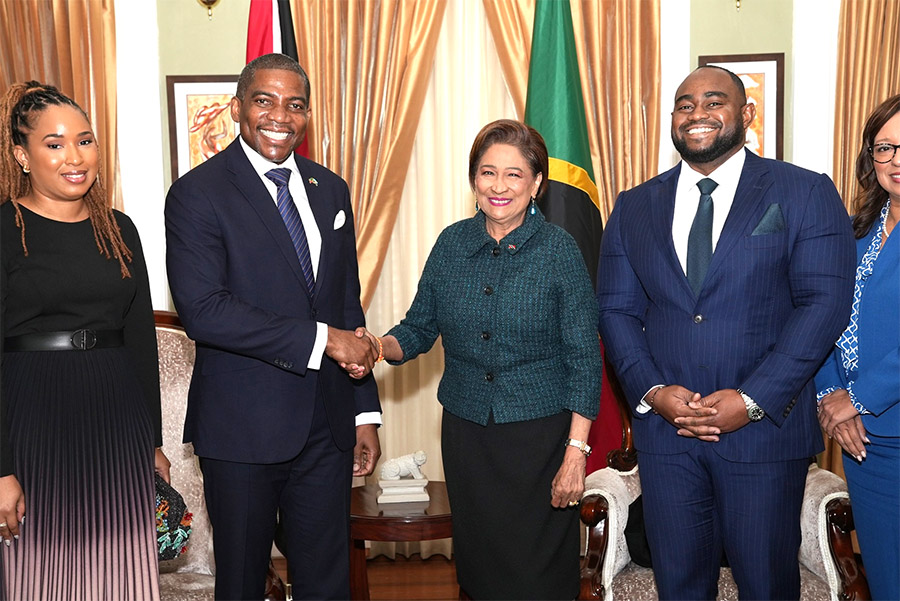



By Corneilus George
Let me not waste time with niceties.
Something is not adding up in this CARICOM matter on the reappointment of the Secretary General, Dr Carla Barnett, and the people of Trinidad and Tobago are being asked to swallow two, now three, versions of the same story that simply cannot all be true. So, I will ask the question plainly, the way people asking it on the street would ask it: Who is telling the truth here?
Two Stories. Then a Third Voice Enters
On the one hand, we are told that Trinidad and Tobago was excluded – “surreptitiously” according to Minister Sean Sobers – from a CARICOM decision to reappoint the Secretary-General. Strong words. Serious allegation.
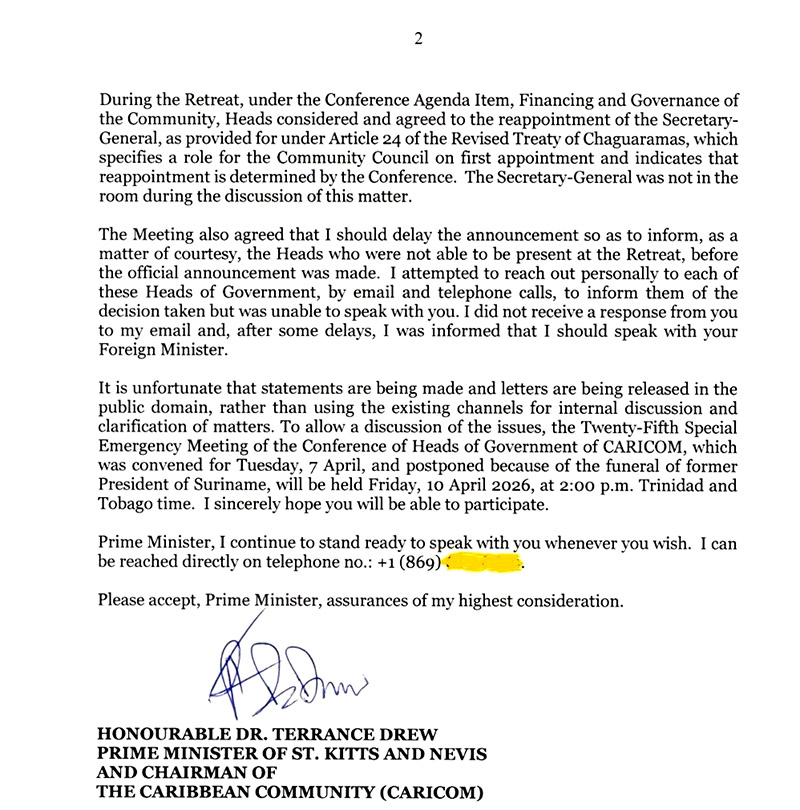
On the other hand, we have, in hand, a formal letter from CARICOM Chairman, Prime Minister Dr Terrance Drew, laying out a timeline that says the exact opposite.
According to that letter:
- Trinidad and Tobago was fully informed,
- the agenda – including the Retreat – was clearly communicated,
- and, most importantly, Trinidad and Tobago left before the meeting where the decision was taken.
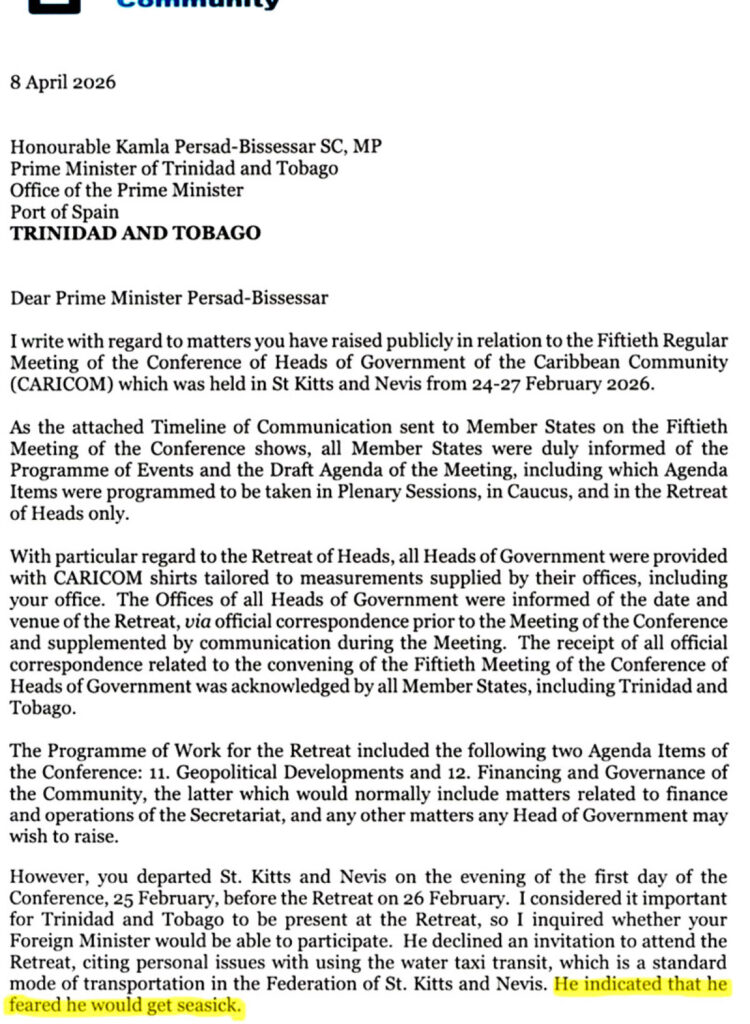
And then comes the part that has the country talking: The Foreign Minister declined to attend, reportedly saying, according the CARICOM Chairman’s letter, he feared he would get seasick.
Now, after the fact, the TT Foreign Minister has since stated publicly that the seasick part was a “joke.”
A joke? In diplomacy? At that level? Let us not insult the intelligence of the population.
But just when you thought it could not get clearer, a third voice has entered the conversation – and it significantly undermines the claim of irregularity.
Guyana’s President, Dr Irfaan Ali, has stated plainly that there was no subterfuge and nothing unusual in the process followed to re-appoint the CARICOM Secretary General.
Read that again. No subterfuge. Nothing unusual.
That is not a commentator. That is a Head of Government from within CARICOM – someone sitting at the same table – confirming that the process was standard, routine, and above board.
So let us take stock T&T: One narrative says we were excluded. Another says we were informed but absent. A third – now from within CARICOM leadership – says everything was done properly. So again: Who is lying here?
You Cannot Miss the Meeting and Cry Foul
Either: T&T was excluded or T&T was absent.
You cannot leave before the decision is taken and then come back to claim you were locked out. That is not how CARICOM works. That is not how any serious institution works.
And when multiple Heads of Government are effectively saying: “Nothing irregular happened,” but the TT Government narrative insists: “We were wronged,” then we are no longer dealing with misunderstanding. We are dealing with manufactured confusion.
Gaslighting, Plain and Simple
Let me call it exactly what it is. This is gaslighting. Not simply crude lies – but something more dangerous: shifting explanations, selective memory and convenient reinterpretation after the fact.
First, we hear: “We were excluded.” Then evidence emerges: “We left early.” Then comes the adjustment: “It was a joke.” And yet the original claim remains untouched. That is not clarification. That is manipulation. It is an attempt to make the population doubt what is plainly in front of them.
Diplomacy Is Not Bacchanal
CARICOM is not a lime. It is not a talk shop. It is not a political platform for grandstanding. It is a rules-based system governed by treaty, procedure, and mutual respect.
You cannot: disengage when it matters, skip the critical meeting, and then return with outrage when decisions are made.
That is not diplomacy. That is bad behaviour – on a regional stage.
And worse than that – it sends a signal to every other CARICOM country that Trinidad and Tobago may not be operating in good faith.
This Is How You Lose Credibility
In public life, you can survive many things but credibility is not one of them.
Because when one CARICOM Head provides documented timelines, another CARICOM Head says the process was normal, and you still insist something improper happened – without producing evidence – then the issue is no longer about CARICOM, It is about credibility collapse.
And once credibility starts to crack, everything else follows naturally: trust at home, influence abroad, and respect in the region.
The Region Is Watching – and Judging
Let’s not fool ourselves, other CARICOM states are watching this unfold.
They are asking: Is Trinidad and Tobago a reliable partner? Does it show up and engage? Or does it rewrite the story after the fact? Because diplomacy is built on consistency.
If your position shifts depending on the audience, you lose leverage. If your narrative changes depending on the day, you lose trust. And in CARICOM, once you lose trust, you lose influence.
Meanwhile – The Real Work Is Being Ignored
While all this noise is going on, at a time when collective regional action is needed to manage foreign exchange pressures, energy transitions and food security, weakening trust within CARICOM is not just political – it is economically reckless. These are the matters that demand leadership.
Instead, we are stuck in a public quarrel – a contrived crisis – one that should never have left the diplomatic room. Even Prime Minister Drew himself indicated that this matter should have been handled through internal channels. But instead, it has been dragged into the public domain and weaponised.
So Let Us Come Back to Basics
This is not complicated. If Trinidad and Tobago was excluded – bring the evidence. If the process was flawed – show where it broke down. If there was miscommunication –
say so clearly.
But do not come to the population with one version today and another tomorrow, while regional leaders are saying something entirely different. Because people are watching. And people are not stupid.
The real danger here is not embarrassment. It is isolation because when a country positions itself against the collective account of its regional partners – without proof – it risks being seen not as a victim, but as a disruptor. And in a small, vulnerable region, that is a dangerous label to carry.
Gaslighting may win a headline. It may win a news cycle. But it does not build credibility. It does not build trust. And it does not build a region.
So, I ask one final time – clearly, directly, without apology: who is telling the truth?
Because until that answer is grounded in evidence – not spin – this remains what it has become: a dangerous distraction from governance and a reckless gamble with Trinidad and Tobago’s standing in an increasingly polarised Caribbean.
