





By Allison Saunders
Let us stop pretending this is a “measured exchange.” This is not a warning shot across diplomatic bows. This is the open use of some of the most lethal and sophisticated weapons in the modern arsenal, and the world is watching in uneasy silence.
The United States has reportedly unleashed Tomahawk cruise missiles, precision-guided, long-range weapons launched from submarines and warships, capable of travelling over a thousand miles before striking their targets with calculated accuracy.
These are not battlefield improvisations. They are instruments of strategic dominance. When Tomahawks fly, it is not theatre; it is a declaration of intent.
Israel, for its part, is believed to have deployed its F-35I Adir stealth fighters, aircraft designed to penetrate hostile airspace undetected, delivering precision-guided munitions such as JDAM bombs or long-range standoff missiles.
The message is unmistakable: no distance is safe, and no hardened facility is beyond reach. This is deep-strike warfare conducted with surgical technology, but surgery can still bleed a region dry.
Iran’s response has been anything but symbolic. Medium-range ballistic missiles, likely variants such as the Shahab-3, Emad, or Kheibar Shekan, have reportedly been launched toward Israel and U.S. installations in the Gulf.
Ballistic missiles are not subtle. They arc high into the atmosphere before descending at blistering speed. They are weapons of spectacle and intimidation. When they rise, entire cities hold their breath.
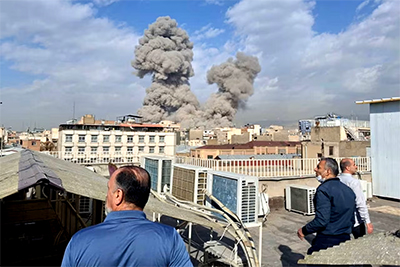
Smoke rises on the skyline of Tehran, Iran, after an explosion
Alongside them, Iran’s arsenal includes the Shahed-series loitering drones, weapons designed not merely to strike but to overwhelm. Drone swarms force air defence systems to burn through interceptors. They stretch reaction times. They create chaos. They turn skies into contested battlefields.
In response, Israel’s Iron Dome, David’s Sling, and Arrow systems ignite across the night sky, while Gulf states activate Patriot missile batteries to defend their capitals.
Every interception is celebrated, but each one is also a reminder that missiles are now crossing borders in live combat. This is no longer a shadow war. This is overt confrontation using first-tier military hardware.
Testing escalation thresholds
And here is the uncomfortable truth: when nations deploy Tomahawks and ballistic missiles against one another, they are not testing each other’s patience. They are testing escalation thresholds.
Cruise missiles are marketed as precise, controlled tools of limited war. Ballistic missiles are framed as retaliatory deterrence. Missile shields are portrayed as stabilising mechanisms. But each of these technologies creates its own illusion of safety. Leaders begin to believe conflict can be calibrated, managed, and contained. History does not support that optimism.
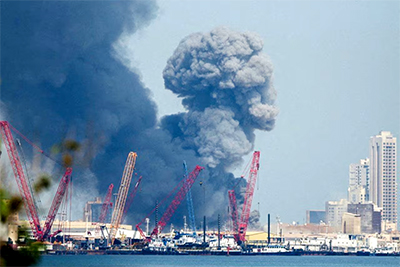
Smoke rises in the sky after blasts were heard in Manama, Bahrain
World wars do not begin with a global vote to ignite catastrophe. They begin with steps, each one justified, each one framed as necessary, and each one described as limited. Then alliances harden, markets panic, domestic political pressures intensify, and retaliation becomes an obligation.
What we are witnessing is the normalisation of high-end state warfare between heavily armed powers in one of the world’s most volatile regions. Oil routes are exposed, airspace is disrupted, civilian populations are living beneath missile arcs, and every major power is calculating its next move. This is not alarmism. It is realism.
Tomahawks and ballistic missiles are not diplomatic notes. They are instruments of escalation. The more they are used, the thinner the line becomes between “regional conflict” and something far broader.
The world today is not merely observing a crisis. It is standing at the edge of one. And when advanced militaries convince themselves that precision equals control, that deterrence equals stability, and that retaliation equals strength, the margin for error narrows to almost nothing.
The matches are already lit. The question is whether anyone still has the will or the courage to put them out.
