





……….ZOSO explained
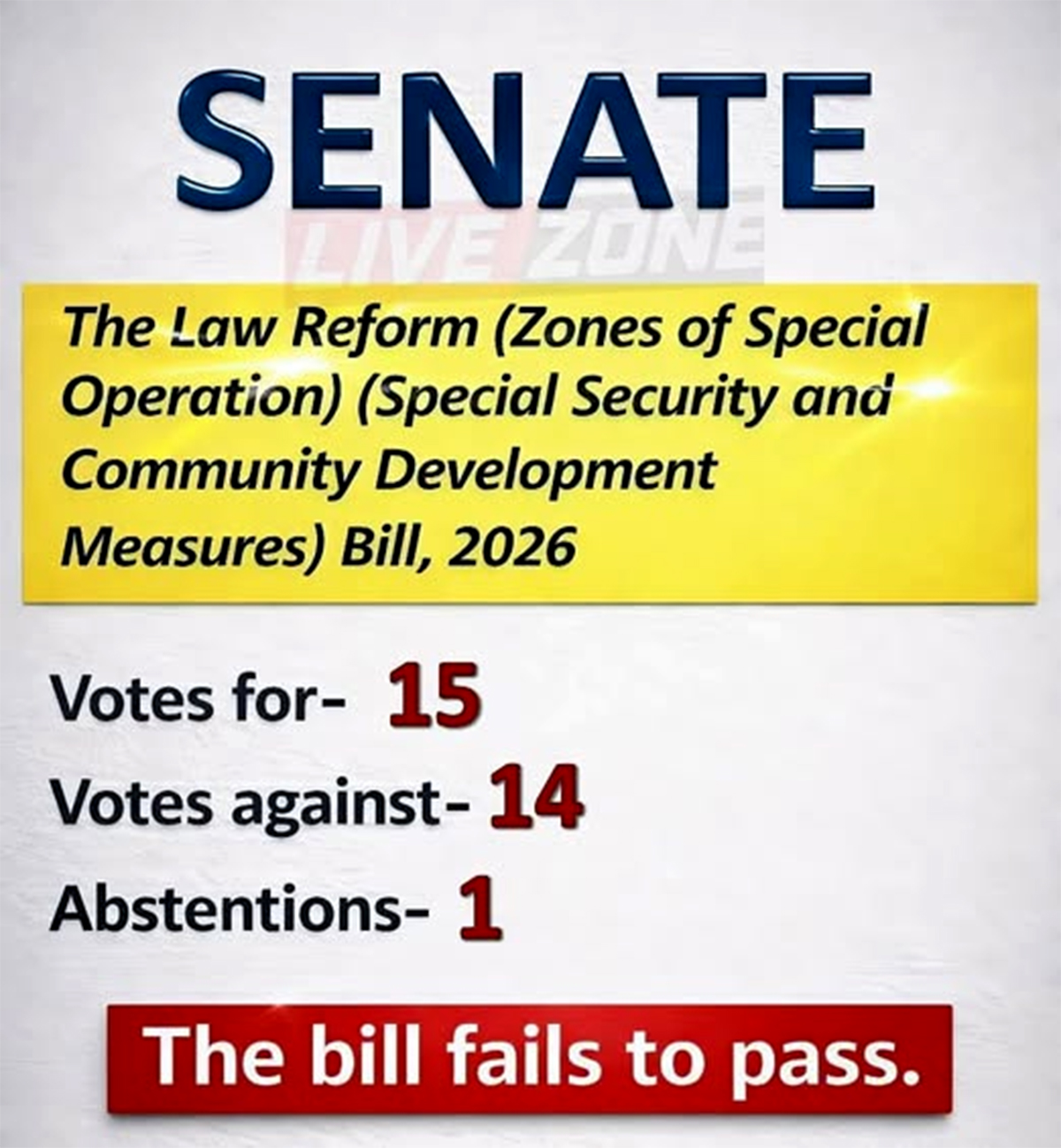
As Trinidad and Tobago struggles with persistent violence and a deep sense of public insecurity, the proposed Zones of Special Operations (ZOSO) legislation has emerged as one of the most consequential policy choices of this period.
The debate around it has been understandably charged. Supporters frame it as a necessary intervention to reclaim communities overwhelmed by criminal control. Critics warn that it risks normalising extraordinary state powers in ways that could erode constitutional rights.
Both perspectives deserve serious consideration, because the issue at hand is not whether the State has a duty to protect citizens; it does, but rather whether the means proposed are legitimate, restrained, and compatible with democratic governance.
The central question is whether ZOSO can be justified as a genuine necessity rather than a convenient shortcut. Emergency-style measures are meant to be used when ordinary tools are demonstrably inadequate.
Trinidad and Tobago already possesses extensive policing powers, criminal statutes, and judicial mechanisms. For ZOSO to be credible, the State must clearly demonstrate why these existing frameworks cannot address the threats in specific communities.
Necessity cannot be asserted simply because crime is high; it must be proven through evidence that targeted, intelligence-led policing and judicial oversight have failed to achieve the required level of safety.
Without that clarity, ZOSO risks becoming a permanent feature of governance rather than a temporary response to exceptional circumstances.
Even where necessity can be established, legitimacy depends on proportionality. Measures such as curfews, cordons, and warrantless searches restrict fundamental freedoms, including movement, privacy, and protection from arbitrary interference.
The constitutional question is not whether the State may restrict rights at all because it can, but whether the restrictions are no broader than absolutely required to achieve their stated objective.
If entire communities are placed under sweeping controls that affect ordinary residents going about lawful lives, the balance tilts away from security and toward collective punishment. A legitimate ZOSO must be precisely targeted at criminal activity, not at geography alone.
Time is another critical dimension. Exceptional powers are dangerous not only because of what they allow, but because of how easily they can become normalised. History, both locally and internationally, shows that measures introduced as temporary responses often outlast the crises that justified them.
If ZOSOs can be declared for extended periods and renewed with relative ease, they risk evolving into a rolling state of exception; one where emergency logic quietly replaces ordinary constitutional standards.
Clear and enforceable time limits are therefore essential, not as a technical safeguard, but as a statement that extraordinary authority must always have an endpoint.
Transparency is equally indispensable. Security operations carried out behind a veil of secrecy corrode public trust and invite abuse. Communities affected by ZOSOs have a right to know why a zone was declared, what powers are being exercised, how many searches and detentions occur, and what outcomes are achieved.
Regular public reporting to Parliament and the population is not an obstacle to effective policing; it is a prerequisite for legitimacy. In the absence of transparency, rumours flourish, fear deepens, and cooperation between citizens and law enforcement weakens, undermining the very objectives ZOSO claims to advance.
Zozo is not inherently illegitimate
Perhaps the most telling test of legitimacy lies in the availability of remedies when things go wrong. No enforcement regime is immune from error or abuse. The question is whether individuals have meaningful avenues to challenge unlawful actions, access legal counsel promptly, and obtain redress when rights are violated.
Rights that exist only in principle but lack practical enforcement are hollow. For ZOSO to be compatible with democratic norms, remedies must be accessible, timely, and effective, and breaches must carry real consequences. Without this, extraordinary powers operate in a space of diminished accountability.
The deeper issue, however, goes beyond the text of any single bill. ZOSO forces Trinidad and Tobago to confront how it governs under pressure. The country is not choosing between liberty and security, but between short-term expediency and long-term constitutional integrity.
Measures that weaken trust in the rule of law may suppress crime temporarily, but they risk planting the seeds of future instability by alienating the very communities whose cooperation is essential to lasting safety.
ZOSO is not inherently illegitimate, nor is it inherently safe. Its legitimacy depends entirely on how rigorously it is constrained, how transparently it is applied, and how seriously the State treats the rights of those living within its boundaries.
If it passes the tests of necessity, proportionality, time-bounding, transparency, and remedy, it would serve as a lawful and useful tool in extraordinary circumstances. If it fails them, it risks becoming a quiet erosion of the constitutional order it purports to defend.
In the end, the measure of a democracy is not how forcefully it can act, but how carefully it restrains itself. Public safety is essential, but so is the preservation of the legal and moral framework that gives that safety meaning.
Trinidad and Tobago must ensure that in confronting crime, it does not lose sight of the principles that define it as a constitutional republic.
