





By Joey Bartlett
Former prime minister Dr Keith Rowley has called Prime Minister Kamla Persad-Bissessar a “jammette” after she accused the People’s National Movement (PNM) of links to criminal financiers during a Parliament sitting on March 13.
Persad-Bissessar alleged the PNM had ties to criminal elements and suggested its headquarters, Balisier House, Port of Spain, was built using proceeds from the drug trade. The claim formed part of a broader contribution in which she criticised the Opposition over crime and governance.
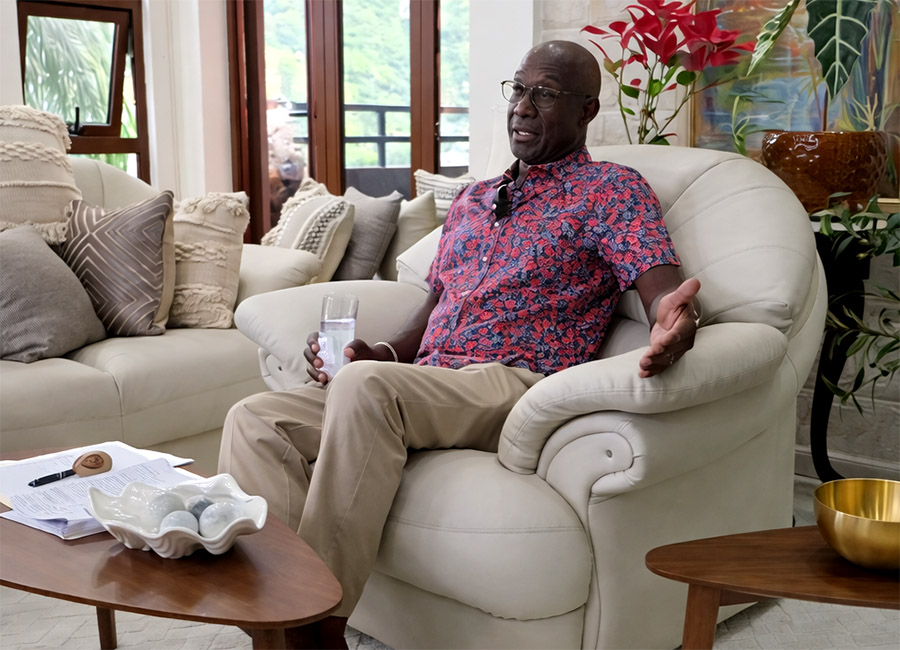
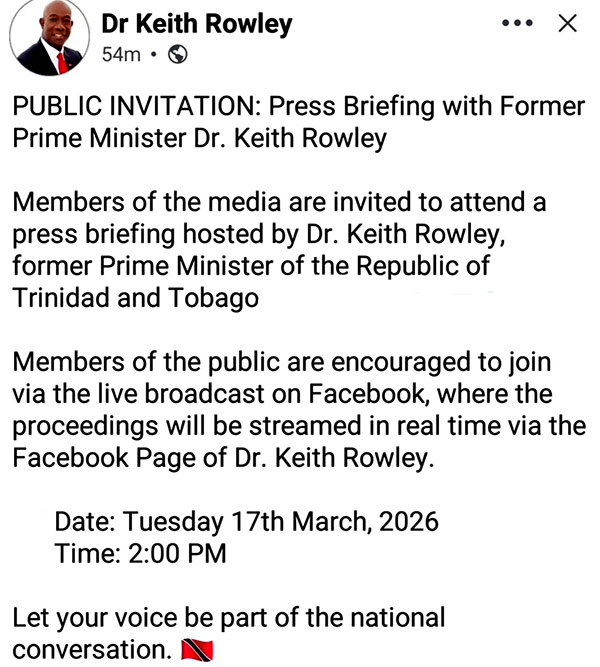
Speaking at his St Ann’s home on March 17, Rowley strongly rejected the allegations and criticised the Prime Minister for failing to provide evidence to support her statements.
“I told this country before you are a jamette, and today, if they (Persad-Bissessar) cannot come in front of me and show me an iota of evidence to support that allegation, I say again we are unfortunate to have a jammette as the prime minister of Trinidad and Tobago,” Rowley said.
He argued that allegations of criminal conduct, particularly against a political party, must be supported by credible proof and not raised in Parliament without substantiation.
“Only a jammette will do something like that… make a statement like that and not be able to provide a modicum of proof or truth to support it,” he added.
Rowley also took issue with other claims made in Parliament, including allegations of serious wrongdoing such as paedophilia, describing them as irresponsible and damaging to public discourse.
He said statements made under parliamentary privilege carry significant weight and should be exercised with caution, noting that unsubstantiated accusations can erode public trust in institutions.
Rowley also addressed foreign policy, national security and governance, offering a wide-ranging critique of the current administration.
On foreign policy, Rowley defended Trinidad and Tobago’s long-standing position of non-alignment, which he said has guided the country since independence in 1962.
He noted successive leaders, including Dr Eric Williams, ANR Robinson and Basdeo Panday, maintained a principled approach that allowed Trinidad and Tobago to engage with global powers while preserving its sovereignty and independence.
“That policy took us from 1962 to the present, allowing us to be respected by all and aligned to none.”
He criticised what he described as the government’s shift towards supporting United States foreign policy positions, including its stance on international conflicts such as those involving Iran and Palestine.
Rowley argued such alignment represents a departure from established policy and could expose Trinidad and Tobago to geopolitical risks.
He warned that small states must be especially careful in navigating global conflicts, as perceived alignment with major powers can have unintended consequences.
“In a turbulent world, the best place for a small nation like ours is to remain non-aligned,” he said.
Rowley also addressed national security, expressing concern about what he described as increasing acceptance of aggressive anti-crime measures without sufficient regard for the rule of law.
Central to his argument was the use of the term “kinetic strikes”, which he said has entered public discussion without clear explanation.
Rowley warned that such language may obscure the reality of extrajudicial killings.
“Extrajudicial killing is the unlawful killing of a person by government authorities, security forces or other agents of the state without due process of law,” he said.
He stressed these actions bypass the judicial system and undermine fundamental legal protections, including the presumption of innocence.
“I am putting the population on notice that this is a clear inducement for our security services to act outside the law,” he said.
He added that crime must be addressed in the framework of the law and not through measures that compromise constitutional rights.
Rowley also questioned reports of foreign involvement in local security matters, raising concerns about transparency and accountability.
He said the government has not adequately explained its policies or the extent of any external collaboration, leaving the public uncertain about the direction of national security strategy.
“We are being asked to accept policies and actions without full disclosure,” he said.
Rowley criticised what he described as a lack of accountability, arguing that leaders must be prepared to explain their decisions and face public scrutiny.
Turning to economic matters, Rowley raised concerns about the management of the energy sector, particularly the liquefied natural gas (LNG) and petrochemical industries.
He warned that poor decision-making and lack of coordination could negatively affect these sectors, which remain critical to the country’s economy.
He noted global market fluctuations, combined with domestic policy challenges, require careful management to avoid conflict between competing interests.
“If these matters are not handled properly, we could see further decline in critical industries.”
He also highlighted ongoing issues related to gas supply and production, suggesting that the government has not been fully transparent about the extent of the challenges.
According to Rowley, mismanagement in this area could have long-term implications for economic stability and growth.
In addition, he raised concerns about Trinidad and Tobago’s international reputation, particularly at institutions such as the United Nations.
Rowley said the country has historically been respected for its independent and principled approach to global issues but warned this reputation could be undermined by perceived alignment with external powers.
“For decades, we built an image of independence and strength. That should not be sacrificed lightly.”
He also referenced the country’s role in CARICOM, emphasising the importance of regional unity and collective decision-making.
Rowley said Caribbean nations are stronger when they act together and warned that unilateral positions could weaken the bloc’s influence on the global stage.
“If we stand together, we are stronger. If we go out alone, we risk being picked off one by one.”
Despite his criticisms, Rowley acknowledged the complexity of the current global environment, noting small states must balance competing pressures from larger nations.
However, he maintained adherence to core principles, including the rule of law, sovereignty and non-alignment, remain essential.
He urged the government to provide greater clarity on its policies and to engage more openly with the public on issues of national importance.
Ultimately, Rowley framed his remarks as a call for careful consideration of the country’s direction, warning that decisions made now could have lasting consequences.
“We must understand what is being done in our name and decide whether it is in the best interest of Trinidad and Tobago,” he said.
