





Editorial
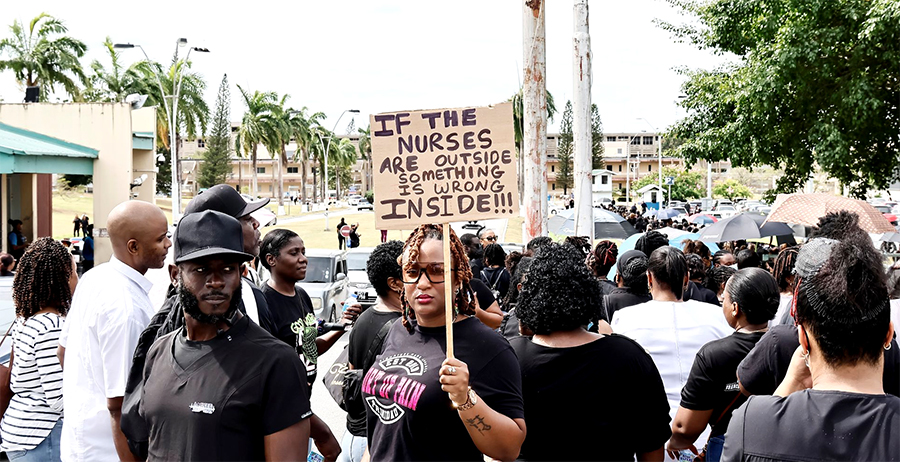
There is something deeply unsettling about how quickly a nation can turn on its caregivers. The unfolding crisis involving nurses in Trinidad and Tobago, whether rooted in alleged misconduct, systemic failure, or administrative breakdown, has triggered a wave of outrage that is both understandable and dangerous.
Understandable, because when healthcare trust is shaken, fear follows, and dangerous, because in our rush to condemn, we risk dismantling the very system we desperately depend on. This is the nurses’ tragedy.
Nurses are the backbone of any healthcare system. They are the first to respond, the last to leave, and often the only consistent presence for patients navigating fear, pain, and uncertainty. They operate under immense pressure: long hours, staff shortages, emotional fatigue, and in many cases, inadequate resources.
Yet, when something goes wrong, it is often the nurse who stands most exposed, most scrutinised, and most easily vilified.
This is not to suggest that wrongdoing should be excused. If there has been negligence, misconduct, or a breach of professional duty, it must be investigated thoroughly and addressed decisively.

Accountability is not optional in healthcare; it is essential, but accountability must be precise, not indiscriminate, and justice must be surgical and not blunt.
The current climate threatens to conflate individual failure with institutional collapse. It invites sweeping judgments about an entire profession based on isolated or poorly understood incidents.
It encourages a narrative in which nurses are no longer seen as caregivers but as suspects. That shift is not just unfair; it is destructive because once trust erodes on both sides, between patients and nurses, and between nurses and the system, the consequences ripple outward.
Morale declines, retention suffers, and recruitment becomes harder. The already fragile healthcare system becomes even more strained, and ultimately, it is the public that pays the price.
If the nurses’ issue is negligence, then strengthen oversight, improve training, and enforce standards. If the issue is systemic: understaffing, burnout, poor supervision, then address those root causes.
If the issue is communication, then build clearer protocols and accountability frameworks, but if the response is to demonise an entire profession, to create an atmosphere of fear and suspicion, then we are not solving anything. We are compounding the crisis.
There is also a broader truth that must be confronted. Healthcare failures rarely occur in isolation. They are often the result of layered weaknesses: policy gaps, resource constraints, management failures, and human error intersecting in complex ways.
To focus solely on the individual at the point of failure, without examining the system that shaped that outcome, is to engage in a convenient but incomplete form of accountability.
It is easier to blame a nurse than to fix a system, but easy answers rarely lead to effective solutions. This moment, as painful as it is, presents an opportunity to examine how our healthcare system supports, or fails to support, its frontline workers.
An opportunity to reassess standards, improve conditions, and rebuild trust. An opportunity to demonstrate that accountability and empathy are not mutually exclusive.
The nurses’ tragedy is not just about what happened. It is about how we respond. Will we respond with clarity, fairness, and a commitment to improvement? Or will we allow outrage to drive us toward reactionary measures that weaken the very system we rely on?
We must resist the temptation to throw out the baby with the bathwater because in doing so, we risk losing not just perspective, but the people who hold our healthcare system together.
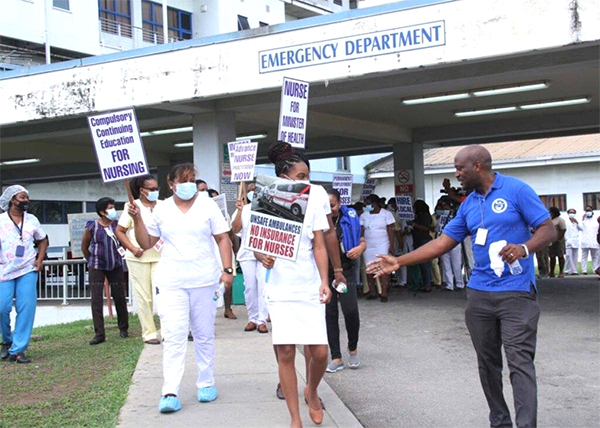
A nurse displays a placard as she and her colleagues enter the Eric Williams Medical Sciences Complex during a protest
