






By Ken Ali
Would Caricom joint the fight against drug traffickers by aligning with America’s Counter-Cartel Coalition?
And if not, is it because of the earlier disclosure of certain Caribbean politicians being in the back pockets of billion-dollar cartel operators?
The coalition is a creature of the Shield of the Americas, whose formation was recently presided over by United States’ President Donald Trump.
Trinidad and Tobago is an active participant in the body, whose mandate is to counter drug trafficking through coordinated intelligence gathering and decisive military action.
With its extensive resources, the US is throwing the most reserves into the campaign, and relative success would staunch the flow of illicit drugs into that country from Latin America.

Prime Minister Kamla Persad-Bissessar, who has continuously pledged to torpedo drug big-wigs, is front and centre in the coalition.
T&T would unite with hemispheric partners “to confront the drug cartels heads-on and restore safety to the region,” PM Persad-Bissessar vowed.
Who feels it, know it!
And as leader of a vulnerable twin-island plagued with drug-running, the Prime Minister acknowledges the pain of bloody crimes associated with the heinous activity.
But bringing down the transhipment industry requires the support of other regional territories, since there are alternative routes out of the Caribbean.
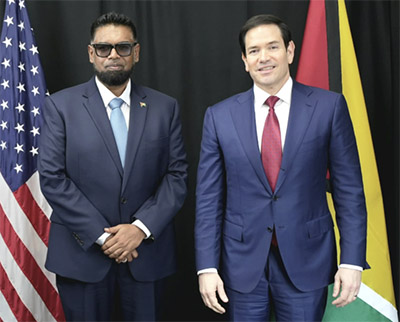
The Caricom Secretariat and regional leaders have shown little appetite to take on the drug battle in spite of the two-decade old Implementation Agency for Crime and Security (IMPACS).
Member countries have had no measurable success in its so-called fight against drug trafficking.
Apart from obvious corruption among certain politicians, police officers and customs officials, the task of challenging the well-equipped drug runners require wide-ranging human and technical resources.
The US-backed counter-cartel coalition is the best effort in years in duelling with those white-collar criminals who use fast-boats and mid-ocean transfers.
Caricom’s Secretary General Dr. Carla Barnett talks a good talk about combating drug trafficking through a regional strategy.
But as her five-year term comes to an end in August, Dr. Barnett has an empty report card on this urgent issue, as, indeed, on various other important matters.
Maybe it’s not her fault.
Leaders of Caricom member nations have not displayed resolve in duelling with the elephant in the room, shielding behind hollow terms like “zone of peace.”
The bitter reality is that the drug scourge has cost the lives of thousands of people in the Caribbean archipelago, even destabilising some societies.
Tiny islands previously renowned for sun, sea and sand, are in the bowels of transshipment from Latin America to lucrative American and European markets.
IMPACS remains a stillborn agency while cartels subvert law and order, buy out public officials, and operate with impunity.
US intelligence reports have revealed how entrenched the trade has become, and the State Department has provided confidential updates to Caricoim leaders.
Six years ago, the regional body was told of the disturbing involvement of Tren de Aragua, an armed and deadly group of Venezuelan mobsters.
The Keith Rowley administration and other regional leadership ignored the worsening scenario, even as the evil trade took human victims through gang warfare, and deepened the offence of money laundering.
The counter-cartel coalition offers a fresh start to effectively confront the drug cartel.
“We welcome the strengthened alliance,” PM Persad-Bissessar said.
Can she count on her Caricom colleagues?
