





By Hugo Maynard
I went down to Mayaro two weekends ago, and the trouble starts long before you get there.
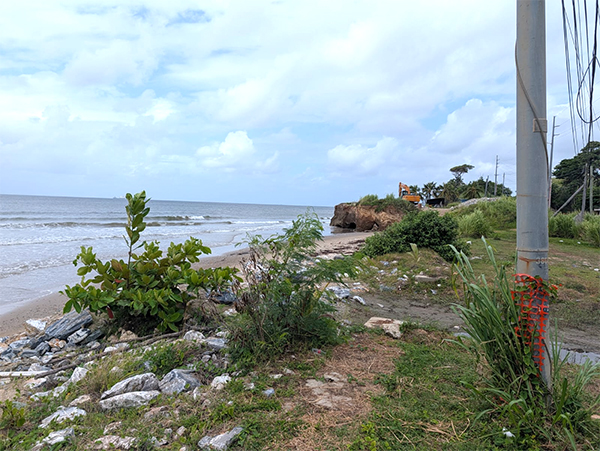
From Sangre Grande all the way in, the road is the problem. Not a stretch of it. Not a patch here and there. The whole run, through Manzanilla and along the Cocal and on into Mayaro, is a road you drive with both hands and no confidence. None of that is new. It has been flooded, bypassed, temporarily rebuilt and complained about for years, and coastal erosion along that shoreline is documented and worsening. What struck me is that nothing about it feels temporary anymore. It feels settled. It feels like the arrangement.
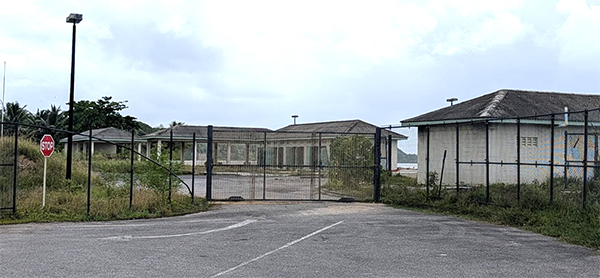
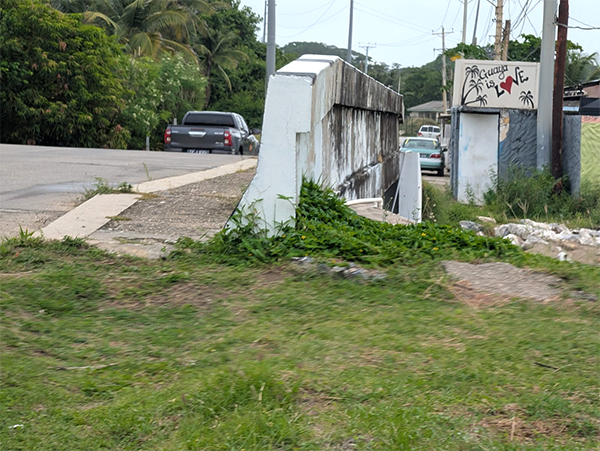
Past the road, the rest. Grass grown high enough to hide a child. Verges long uncut. Drains choked with silt and bush. Public spaces plainly waiting on a crew that has not come. The sea never disappoints, and the palms still lean over the sand the way they do in the calendar photographs, but almost everything between the road and the water looked untended. I will call that what it is, one man’s observation on a Saturday and not a condition survey. But I have been travelling to Mayaro since I was a boy, and I know deterioration when I am driving through it.
Here is the question I could not put down on the way home. How does a place like this end up looking like this?
Because Mayaro was never a village history overlooked. Its recorded story reaches back to a Catalan Capuchin mission in 1690. Lord Harris later drew a county of some 150 square miles around that one southeastern settlement and named the county after it. The estates of the Cocal shaped the coastline, fishermen pulled seine there and still do, and by the middle of the last century Mayaro was being described as the largest village in Trinidad and one of the fastest growing places on the island. The reason given was oil and gas off Punta del Galeota.
That is the part we have quietly stopped saying out loud. Randolph Rust and John Lee Lum sank the first commercially viable wells at Guayaguayare in 1902. The Galeota terminal opened in 1972 and still processes the liquids from bpTT’s offshore facilities and other producers. The gas that feeds Atlantic LNG at Point Fortin and the industrial estate at Point Lisas comes ashore in that same corner of the country. The southeast is not a place that used to matter. It is where the money still walks in from the sea.
Let us put two numbers beside each other.
For 2022, the Extractive Industries Transparency Initiative reconciled payments to the Government from 52 oil and gas entities at just over $31 billion. One year, one industry, much of it produced off the coast I was driving along.
For fiscal 2026, the recurrent allocation to the Mayaro Rio Claro Regional Corporation is $70 million. That is the body responsible for secondary roads, drains and public spaces across 852 square kilometres and 39 communities holding more than 36,000 people, the second largest municipal landmass in Trinidad. Port of Spain got $210 million. Diego Martin got $160 million. Tunapuna Piarco got $160 million.
I am not pretending those are the same job. Cities cost more to run. But if the country’s hydrocarbons come ashore in the southeast and the southeast administers the second largest territory in Trinidad on five per cent of the municipal pot, then the state of that road is not a mystery. It is arithmetic.
Money is not even the whole story, which is the part that should annoy us most. In fiscal 2025, local government road rehabilitation nationally had $94.5 million available and spent $25 million of it. In fiscal 2024, the state paid $499 million to the Community Based Environmental Protection and Enhancement Programme, which is the country’s own grass cutting and clean up arm. Half a billion dollars a year on community environmental enhancement, and the verges on the way into Mayaro look the way they do. Somebody should be able to explain the distance between those two sentences.
Nobody can, and that is the third problem. The Auditor General reports that 104 sets of financial statements from municipal corporations remain outstanding, and Mayaro Rio Claro’s are missing for the six years from 2018 to 2023. Audited statements for the CEPEP company covering the same six years were not provided for examination, and documents supporting $55.65 million in payments to it were not produced for audit. When accounts go unfiled that long, nobody can say with authority where maintenance money went or whether it was ever enough. This is not a partisan point. Twelve other corporations are on the same list, under governments of both stripes.
We should be worried, because we have watched this film. Forest Reserve, in the Fyzabad district, is where the syndicate that became Trinidad Leaseholds took colonial leases from 1913 and the new wells beat every expectation. That single field has yielded more than 500 million barrels. It is where oil workers struck in June 1937 and where this country’s organised labour movement was born. Then onshore production fell away from the 1980s, the businesses living off oilfield wages went with it, and the town spent decades in a slump. Idle pumping jacks. Access roads under bush. Rusting pipe across fields. Importance did not protect it.
Mayaro is not Forest Reserve, and that is the whole argument. Forest Reserve declined because its industry declined. Mayaro is looking rough while its industry is still working, which is a failure of a different and more embarrassing kind.
Which brings me to Nicholas Morris, and I want to be fair to the man before I ask him for more.
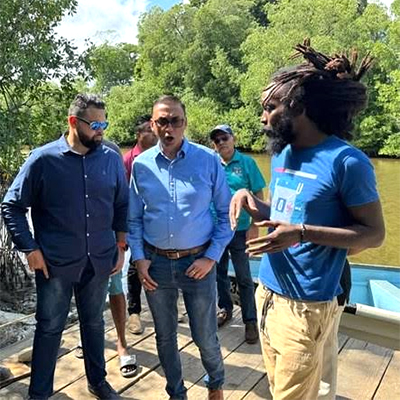
He has held the seat since April 2025, elected with just over seventy per cent of the vote, and now sits as a Minister in the Office of the Prime Minister. He has not been idle. A fire tender arrived. Cabinet approved two tank farms and a desalination plant. A joint army police post is coming. Access roads, a landslip and the collapsed Charuma Road are on the list. When he says you cannot correct “120 months of neglect in 12 months,” he is not wrong, and no fair critic would pretend otherwise.
But look at what he brought to the seat. An MBA in oil and gas management. Nine years as an opposition parliamentary researcher on energy affairs. There is no member of that House better equipped to stand up and argue that a district which lands the nation’s gas should not be maintained like an afterthought. So make it, sir. Not the constituency shopping list. The structural case.
Three things would show it. Rehabilitate the Sangre Grande to Mayaro corridor as one funded project with a maintenance line attached, instead of a rolling series of emergencies. Publish a verge cutting and drain clearing schedule so upkeep becomes routine rather than an event before an election, and let residents see the dates. And put a Mayaro development plan on paper with a horizon longer than a budget cycle, one that treats the beach as an economic asset rather than a postcard. Seventeen miles of shoreline with nowhere to buy a meal or change your clothes is a wasted national holding. Return the old post office to service as the museum it was once earmarked to be. Formalise the guesthouse trade. Add value to coconut and fish in the district instead of shipping both out raw. Tie the Galeota operators into all of it through agreements with teeth rather than photographs.
While that is happening, ask your corporation to file its accounts. Six years is long enough.
Mayaro does not need the oil boom back. It needs a Mayaro equal to its own history, its people and the coastline it was handed. We have discussed life after oil for forty years as though it were a weather system approaching from somewhere else. In the southeast it has already made landfall, and the question it leaves is not really about one village on the east coast. It is whether Trinidad and Tobago intends to keep the communities that built it, or simply finish using them.
