


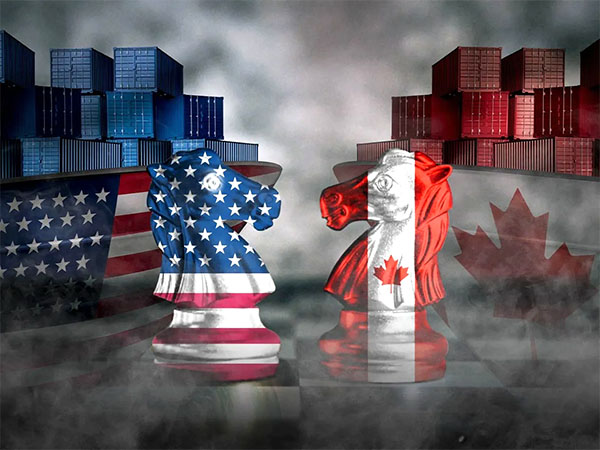



Dear Editor, The escalating trade confrontation between the United States and Canada should not be regarded in Trinidad and Tobago as somebody else’s economic quarrel. Trade wars undoubtedly create casualties: tariffs increase prices, disrupt established supply chains, discourage investment and force businesses to reconsider markets that were previously secure, but disruption also creates opportunity. When two countries involved in one of the world’s largest bilateral trading relationships deliberately make each other’s products more expensive, suppliers elsewhere should immediately begin looking for the spaces being created. Trinidad and Tobago should be among them.
Canada’s retaliatory tariffs on American products create an important opening. We cannot replace the United States as a supplier to Canada, nor Canada as a supplier to the United States; we do not need to. Their bilateral trade is so enormous that capturing even a tiny fraction of commerce displaced by tariffs could represent significant new business for an economy the size of ours.

The Government should therefore establish an urgent Canada–U.S. Trade Diversion Task Force, bringing together the Ministry of Trade and Industry, ExporTT, manufacturers, energy companies, chambers of commerce, shipping interests and our diplomatic missions. Its mandate should be practical rather than academic: examine the products affected by tariffs and determine what Trinidad and Tobago already manufactures, what we could quickly expand and where our exporters could become competitive because tariffs have changed relative prices.
Consider the economics. A Trinidadian product that was previously 15 per cent more expensive than its American competitor might suddenly become attractive to a Canadian importer if the American product now carries a 25 or 50 per cent tariff. Similarly, American companies facing higher prices for Canadian products will search for alternative suppliers. We should know precisely where those opportunities exist.
Energy and petrochemicals provide an obvious starting point. Trinidad and Tobago already possesses sophisticated industrial infrastructure and expertise in natural gas, ammonia, methanol and downstream manufacturing, but our ambitions should extend beyond energy. We should examine chemicals, packaging, processed foods, beverages, selected manufactured products, and value-added agricultural goods.
Canada’s food market deserves particular attention. We cannot compete with North American agriculture on acreage or volume, but we can compete in speciality markets. Trinidad and Tobago produces sauces, seasonings, cocoa products, beverages, tropical foods and distinctive Caribbean products. Canada’s substantial Caribbean diaspora offers a natural entry point for local producers to expand into the broader Canadian market.

But finding an opportunity is useless if we cannot deliver. This trade dispute exposes some longstanding weaknesses in our diversification agenda. Port efficiency, shipping frequency, customs procedures, product certification, export financing and bureaucratic delays determine whether an exporter can respond when an overseas buyer needs a replacement supplier. Canadian and American businesses reorganising their supply chains will not wait while Trinidadian companies struggle through months of paperwork.
We should also pursue Canadian investment aggressively. If Canadian companies are seeking to reduce their dependence on the American market, Trinidad and Tobago should offer itself as a manufacturing, energy-services and distribution platform connecting the Caribbean with northern South America.
Our geography supports that argument. We sit just off the South American mainland, have established ports and industrial estates, possess an experienced energy workforce and provide English-speaking financial and professional services. Investors should therefore be encouraged to see Trinidad and Tobago not simply as a market of approximately 1.4 million people, but as a strategic gateway into CARICOM and Latin America.
Washington requires an equally deliberate strategy. The United States is already one of our largest trading partners. Where American manufacturers seek alternatives to Canadian inputs affected by tariffs, Trinidadian businesses should be standing at the door.
This means our embassies must become commercial intelligence centres. Our representatives in Ottawa, Toronto and Washington should monitor tariff changes, identify companies looking for alternative suppliers, arrange business-to-business meetings and transmit commercial opportunities to Trinidad and Tobago in real time. Twenty-first-century economic diplomacy must involve finding markets, attracting investment and opening doors for national businesses.
There is also a CARICOM dimension. No individual Caribbean economy possesses sufficient scale to exploit all the opportunities emerging from disrupted global supply chains. Collectively, however, the region possesses energy, minerals, agriculture, manufacturing capacity and professional services. Regional production chains could allow one country to supply raw materials, another to manufacture and another to provide logistics. Integration should become an economic instrument rather than merely a diplomatic aspiration.
There must nevertheless be caution. Trinidad and Tobago should never become a convenient transhipment point through which American or Canadian products are repackaged to circumvent tariffs. Rules of origin must be respected. The objective must be genuine Trinidad and Tobago production, employment, exports and value creation.
Neither should we construct industries that survive only because temporary tariffs make competitors expensive. The smarter objective is to use this period of disruption to establish commercial relationships that can survive when the trade dispute eventually ends.
For decades, Trinidad and Tobago has spoken about diversification as though opportunities will patiently wait until we are ready; they will not. Global commerce moves rapidly. Supply chains break, relative prices change, and businesses search for alternatives.
Somewhere in Canada, an importer may already be searching for an alternative American supplier. Somewhere in the United States, a manufacturer may be looking for an alternative Canadian product.
We did not start this trade war and cannot determine how it ends. What we can determine is whether Trinidad and Tobago watches from the sidelines or moves intelligently to capture some of the opportunities it creates.
The challenge to our government and business community is therefore straightforward: make sure those companies find Trinidad and Tobago before they find somebody else.
Yours faithfully,
A Concerned Citizen
