





By FRANCIS JOSEPH
There is nothing wrong with the Police Service policy governing the use of tear gas. But like everything else, it can be improved.
This was the ruling of the Court of Appeal on Wednesday in the appeal brought by Nicole Jordan-Alexis in a judicial and constitutional challenge brought against the Commissioner of Police.
Justices Prakash Moosai and Charmaine Pemberton dismissed the appeal, finding that Jordan-Alexis had failed to establish an arguable case with a realistic prospect of success that the Police Service policy was unconstitutional or that the police acted unlawfully, irrationally or unreasonably.
However, the judges acknowledged concerns about the policy’s lack of detail concerning tear gas. The judges said, “The contents of the policy as framed within the document, however, leave a bit to be desired.”
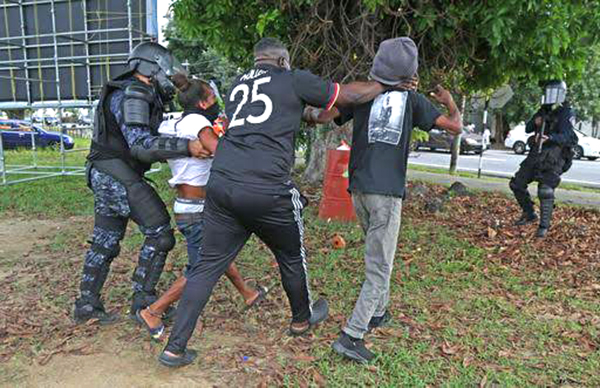
Jordan-Alexis claimed she was attending a prayer and reflect event at the Queen’s Park Savannah on January 16, 2022, when police deployed tear gas. She said she experienced burning, coughing, difficulty breathing and temporary blindness.
The Police evidence was that about 1,000 people were involved in an unauthorized gathering and that officers had repeatedly called on the crowd to disperse before tear gas was used after other crowd-control measures failed.
The Appeal Court also found that Jordan-Alexis’ evidence was insufficient to establish that adequate warnings had not been given. The Court noted the absence of medical evidence and supporting witnesses, and said her position was weakened by the fact that she had moved about 550 metres from the Savannah before experiencing the effects of the gas.
THE CASE
Jordan-Alexis sought leave to apply for Judicial Review in relation to two aspects of relief:
(a). Relief in Judicial Review:
* A declaration that the policy is unlawful, null, void and of no effect;
* A declaration that the application and use of the policy by the CoP on the 16th of January 2022 was irrational, unreasonable and unlawful; and
* An order of certiorari to bring into the High Court of Justice and quash the policy of the Police Service.
(b). Relief under the Constitution of the Republic of Trinidad and Tobago:
* A declaration that the application and use of the policy breached the woman’s right to security of person and right to the protection of law per sections 4 (a) and (b) of the Constitution of the Republic of Trinidad and Tobago (hereinafter called “the Constitution”). Therefore, Jordan-Alexis challenged the constitutionality of the policy itself and the application/use of the policy on the 16th of January 2022.
THE FACTS
Jordan-Alexis’ evidence was that she participated in a prayer event at the Queen’s Park Savannah. Also present were other members of the public who were demonstrating. She said that police officers were present and dressed in riot gear, including helmets, gloves, body armour and plastic shields.
Further, there was an interaction between the officers and the lead worshippers whereby she was carried to a side, where the officers conversed with her. Subsequently, the lead worshipper was arrested. Upon witnessing the arrest, other participants of the prayer event began questioning the police officers in relation to the arrest. She observed some participants being escorted to a nearby police bus, where they were detained.
She said at no time did she observe the police officers ask or advise persons to leave the Savannah or give warning about the consequences of the failure to leave the Savannah. After the scene at the Savannah became increasingly contentious, she left the Savannah.
Upon reaching the proximity of the TGI Fridays restaurant, she observed what appeared to be smoke in the air. A burning sensation followed this in her eyes and skin. Jordan-Alexis stated that she realized that the officers had fired a tear gas canister in the vicinity of the Savannah.
She said there was no prior warning from the officers.
She did not observe the officers using a megaphone or loudspeaker to warn the participants to leave the Savannah or that tear gas would be used. No assistance was rendered by any police officers as to the safest and quickest route to exit the Savannah without being harmed or injured.
The evidence of the Commissioner of Police put in dispute practically every fact alleged by Jordan-Alexis. There was no admission by the CoP that the woman was near the Savannah or engaged in prayer activities at the time in question.
The statutory provision made it clear that the officers may use reasonable force to prevent crime and preserve peace in instances of riot.
The Covid-19 regulations and the ongoing pandemic conditions at the time were duly noted. On the 16th of January 2022, as evidenced in the Affidavit of Officer Avalon Frank, there was an unauthorized protest at the Queen’s Park Savannah. At the time of the said unauthorized protest, Public Health Regulations prohibited any gathering exceeding ten persons.
Officers monitored the unauthorized protest, and the crowd was estimated to be around 1,000. The Affidavit of Officer Frank stated that Supt Lancaster-Ellis had permitted the crowd to do one lap around the Savannah before they were required to disperse. Upon completing the lap, the crowd attempted another lap and was instructed to disperse.
Frank observed that the crowd was boisterous and riotous as people chanted aggressively, obstructing the roadways and refusing to disperse. He stated that the officers explored various methods to disperse the crowd. The evidence of Officer Frank was that both the Tear Gas Policy and the Use of Force Policy govern the police actions when contemplating the use of non-deadly force such as tear gas.
The Use of Force Policy contained the methods used on the day in question. These included the presence of police dressed in riot gear. Also, communication was utilized; that is, the officers formed a running line to contain the crowd and made intermittent requests for them to disperse.
Additionally, persons had been arrested and detained. He said, nevertheless, the crowd showed no signs of dispersing, and as such, he assessed that the fifth degree of force should be utilized, that is, the issue of tear gas. Further, he said that before the gas deployment, he evaluated the surroundings and concluded that it was an appropriate environment as the Queen’s Park Savannah is an open air space, well-ventilated with multiple exits.
Persons could easily flee if affected by the gas. Also, he confirmed that the officers did not have their own megaphones, which were non-functional at the time. However, he stated that he and other officers shouted to the crowd loudly on multiple occasions to disperse or gas would be deployed. Therefore, he denied that there was no prior warning. He stated that the warning was made in the vicinity of the Savannah itself.
Persons at TGIF were not addressed, given the proximity of TGIF, about 550 metres from the Savannah. After announcing the intention to deploy the gas, Frank’s evidence is that the crowd became even more riotous and began throwing missiles in the direction of the police officers.
After non-compliance and the crowd’s hostility, he instructed that the gas be deployed. Given the size of the crowd, which spanned from the top of Frederick Street to TGIF, he said it was necessary to deploy six canisters of gas consecutively.
Jordan-Alexis was represented by attorney Michael Rooplal, while the Office of the Commissioner of Police was represented by Alana Rivas and Leah Mendoza.
