






By Peter Green
At a time when Trinidad and Tobago should be singularly focused on confronting an unrelenting crime crisis, the public is instead witnessing a troubling spectacle at the top of its law enforcement leadership.
The ongoing friction between former police commissioner Gary Griffith and current Commissioner of Police Alister Guevarro has spilled into the public domain, drawing attention, consuming oxygen, and distracting from the one issue that truly matters: crime is tightening its grip on the nation.
While they spar, crime does not pause; it advances with a brutality and frequency that would unsettle even the most hardened observer. Murders continue unabated despite the imposition of a state of emergency. Homes are still being invaded, robberies persist at a pace that defies comprehension, illegal firearms continue to flow into the country, and gangs remain firmly entrenched.
All the while, there appears to be little meaningful effort to shift the narrative or reality, leaving Trinidad and Tobago firmly under the harsh spotlight as one of the most violent countries per capita in the world.
Behind the reality are communities under siege. Families are living with a quiet, persistent fear. Business owners are factoring security costs into survival. Parents are recalibrating how and where their children move. This is not abstract data; it is our lived reality, one that demands absolute focus from those entrusted with national security. However, what the public sees instead is division.
Leadership in policing is not merely operational; it is symbolic. It sets tone, direction, and confidence. When that leadership appears fractured, when disagreements between senior figures play out publicly, it sends a signal that extends far beyond personalities. It suggests a system that is not fully aligned at a time when alignment is critical, and criminals are quick to interpret weakness.

The Trinidad and Tobago Police Service has repeatedly acknowledged that gang networks and illegal firearms remain the primary drivers of violent crime, with intelligence estimates pointing to over 100 active gangs operating across the country. The challenge is not unknown. The strategies are not unfamiliar. But execution requires cohesion, discipline, and sustained coordination. Public disputes undermine all three.
The disagreements are corrosive
This is not to suggest that differences of opinion should not exist. In any serious institution, debate is inevitable and, when managed correctly, productive. But when those disagreements spill into the public arena, when they take on a personal tone, when they are framed through competing narratives, they cease to be constructive; they become corrosive, and the cost is measurable.
Every hour spent on rebuttal is an hour not spent on strategy. Every public exchange chips away at confidence. Trust in law enforcement, already fragile, becomes harder to sustain when the perception of unity is replaced by visible discord. In a country where detection rates for serious crimes remain a concern, perception matters almost as much as performance.
The issue, then, is not who is right or who is better because neither of the two has left any footprints in the sand to suggest success at crime fighting in this country. At a time when illegal firearms continue to enter the country through porous borders, when drug trafficking routes intersect with local gang activity, and when communities are calling for visible, consistent policing, the margin for distraction is effectively zero.
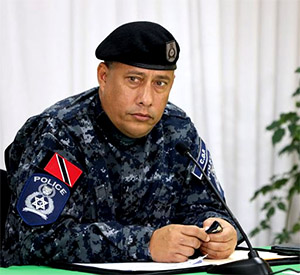
That is why restraint is not optional; it is essential. That is why Griffith, as a former commissioner, should remain silent, and why Guevarra, the commissioner on record, should focus on the job at hand.
Those who occupy, or have occupied, positions of authority in national security must understand that their words carry consequences. They shape morale within the ranks. They influence public confidence. They can either reinforce a sense of control or deepen a perception of drift. Right now, the balance is tilting in the wrong direction.
The country does not need competing narratives. It needs coordinated action. It does not need public sparring. It needs measurable results. We need a system that is focused, aligned, and relentlessly committed to restoring order because crime is not waiting; it is evolving, adapting, and exploiting every gap it finds. In that environment, even the appearance of division is a liability.
The tragedy is that this moment demands what should already exist: a unity of purpose. Instead, the nation is left watching a dispute unfold while the statistics continue to climb and the human cost continues to mount.
While they argue, the nation continues to bleed in numbers that should leave no room for anything but focus. Griffith had his chance; now it is Guevarra’s turn. What is so hard about that to understand?
