





By Dr Jack Austin Warner
Rowley’s statement is not a defence. It is an exhibition. What stands out immediately is not moral force, not injured dignity, and certainly not statesmanship; it is spite. The language is accusatory, coarse, and vindictive.
Instead of rebutting the allegation of Balisier House being built with drug money with facts, dates, documents, or a financial explanation, Rowley resorts to indignation, personal attacks, and grievances. That is the first weakness.
A former prime minister confronted with a serious claim about Balisier House should instinctively respond with evidence. Rowley instead responds with rage.
That matters because his post does not exist in isolation. It sits in continuity with the tone of his press conference and with a public style that has repeatedly descended into belittlement when women are involved.

The “Jamette” reference to Kamla Persad-Bissessar was not some random lapse detached from the rest of his conduct. This Facebook post deepens the same pattern. Here again, he does not merely challenge the Prime Minister politically; he reaches for language meant to degrade her personally.
The phrase about “play she punters” is especially ugly. It is not the language of rebuttal; it is the language of humiliation. It seeks not simply to contradict a political opponent but to dirty her in the public imagination.
That is precisely why the statement should be read as part of a broader problem in Rowley’s political conduct. His defenders may argue that he is only responding in kind, that politics is rough, and that he is entitled to hit back.
But public office imposes a higher burden. Former prime ministers do not get judged only by whether they can wound; they are judged by whether they can restrain themselves when wounded. Rowley has failed that test here.
His post also reveals a deeper evasiveness. He asks where TATT was in earlier controversies, raises Jack Warner, invokes past political offensiveness, and broadens the argument into hypocrisy, but all of that is a diversion.
Even if every charge of double standards were true, it would not answer the central issue: did the PNM finance Balisier House properly, and can that be clearly demonstrated? What he offers instead is the oldest manoeuvre in politics: change the subject, inflame the atmosphere, and make the debate about tone only after you yourself have poisoned it.
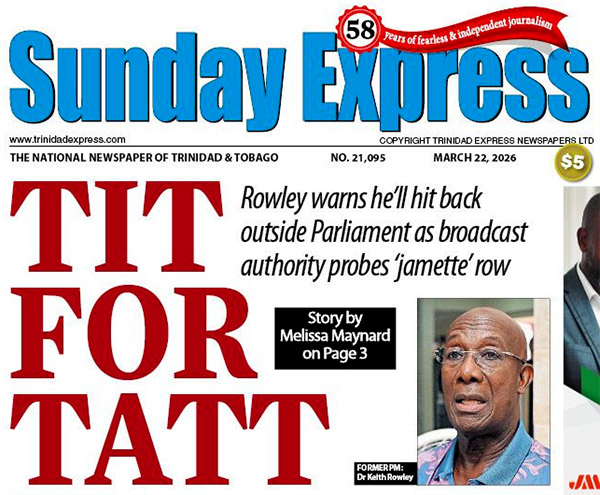
So, was TATT wrong in warning media houses about the publishing of demeaning language? In principle, no. Not if the concern was to discourage the normalisation of degrading and inflammatory language in the public sphere.
A regulator cannot be indifferent when political vulgarity is amplified into mass discourse, especially in a country already exhausted by toxic politics. Media houses also have a responsibility.
Freedom of expression does not require the press to become a conveyor belt for abuse. Editors make choices every day about what to highlight, what to contextualise and what to reject. Warning against demeaning language is not, by itself, censorship; it can be a legitimate attempt to defend minimum standards of civility.
However, there is an important condition: that standard must be applied evenly. If TATT speaks only when one side offends and falls silent when another does the same, then its warning becomes selective morality dressed up as principle.
The problem is not regulation; the problem is consistency. The public will only trust such interventions if they are neutral, transparent, and universal.
Still, on the evidence of this statement, Rowley has no moral advantage to claim. His own words justify scrutiny. He is not the victim of a hypersensitive media culture. He is a seasoned political actor who again chooses to communicate through insults, innuendo, and contempt.
That is why this episode matters. It is not merely about one post or one press conference. It is about whether Trinidad and Tobago will continue allowing political men, like Rowley, to continue to degrade women in public life and then call it a robust debate.
Rowley’s statement answers that question in the worst possible way. And that is why TATT’s concern, at least in principle, is justified.
