


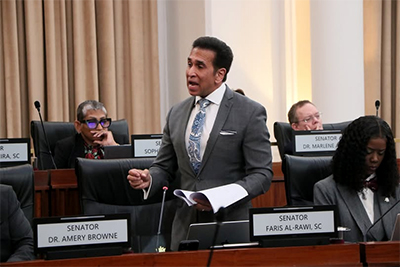



WHY IS FARIS AL-RAWI STILL IN OUR PARLIAMENT?
By Peter Green
There are legal defeats. And then there are institutional collapses.
The reinstatement of a $20 million malicious prosecution judgment against the State is not simply a courtroom setback. It is a governance failure of the highest order. The most alarming fact is not the size of the award. It is this: the Attorney General failed to defend the claim at inception. Let that settle.
At that time, the Attorney General of Trinidad and Tobago on record was Faris Al-Rawi. Today, Faris Al-Rawi sits as an appointed Senator in Parliament under the People’s National Movement.
The question now confronting the public is unavoidable: can a former Attorney General under whose watch the State failed to contest a multimillion-dollar malicious prosecution action credibly occupy a seat in the Legislature without first accounting for that failure?
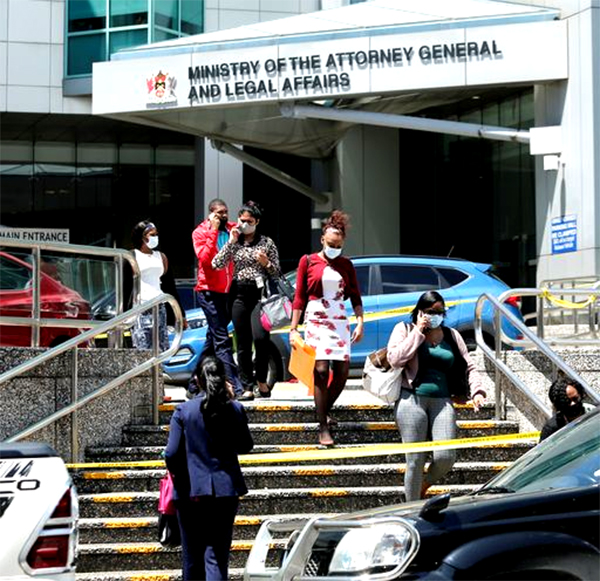
Office of the Attorney General
Malicious prosecution is not a routine civil matter. It strikes at the core of prosecutorial integrity. The elements are exacting: institution of proceedings, termination in favour of the claimant, absence of reasonable and probable cause, and malice.
The State ordinarily contests such claims vigorously. Yet here, the action moved forward undefended; default judgment was entered, and quantum was assessed. Only later did the Attorney General’s office attempt to undo what had already been lost.
This is not an adverse judgment after trial. It is a collapse of litigation management. The distinction is critical. As Attorney General at the time the default judgment was entered, Al-Rawi was the constitutional guardian of the public purse in civil proceedings.
The office carries a fiduciary dimension: to defend claims, to protect public funds, and to ensure that the machinery of State litigation operates competently. Twenty million dollars does not disappear because the law was weak. It disappears when the State does not show up.
How did this happen? Was the claim improperly served and overlooked? Was there systemic dysfunction within the Attorney General’s Chambers? Were internal safeguards absent? These are not partisan questions. They are questions of public accountability.
$20m may not be no big thing to Al Rawi
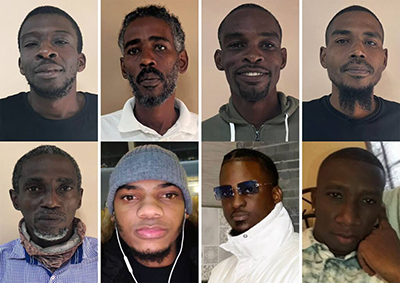
The eight men acquitted of murder in 2016 and awarded $20m
Now that Al-Rawi has been appointed to the Senate, those questions take on sharper constitutional edges. Parliament is not merely a debating chamber; it is the institution that scrutinises executive conduct and safeguards the public interest.
When a former Attorney General, under whose tenure a $20 million default was entered, takes a seat in that body, the public is entitled to ask whether the threshold of accountability has been met.
There is also a more severe inquiry: does this failure rise to the level of misbehaviour in public office? The offence of misbehaviour in public office requires more than negligence. It demands willful misconduct or reckless disregard of duty to such a degree that it amounts to an abuse of the public’s trust.
It is not triggered by an honest administrative error. But where a public officer knowingly neglects to perform a duty that results in grave financial consequences, scrutiny becomes unavoidable.
Was the failure to defend this action mere incompetence, or was it reckless indifference? Did the then Attorney General Faris Al Rawi know of the claim and fail to act? Or was the office so mismanaged that constitutional duty dissolved into procedural chaos?
An independent review is not a luxury; it is a necessity. Public confidence in institutions depends on visible accountability. If the failure was systemic, reform must follow. If it were personal dereliction, consequences must follow.
The issue is not whether Al-Rawi is politically valuable to his party. The issue is whether the integrity of Parliament is strengthened or weakened when serious unanswered questions linger over a former holder of high constitutional office.
The Attorney General’s office cannot be shielded from scrutiny simply because it sits at the apex of State litigation. Faris Al-Rawi would agree that the higher the office, the greater the obligation to answer.
Twenty million dollars may be no big thing for Al Rawi but in a nation now struggling economically to survive it represents schools, healthcare, infrastructure, and public goods financed by citizens who expect diligence from those entrusted with power. When that diligence fails, elevation without explanation feels less like continuity and more like evasion.
Before the nation turns the page, it deserves answers. How did the State fail to defend itself? Who was responsible? And has that responsibility been confronted honestly?
Public office is a privilege, not an entitlement. Accountability is not optional. It is the price of trust. The courts have spoken. Now Al Rawi must answer: how did the State fail to defend itself under his watch, and who bears responsibility?
