


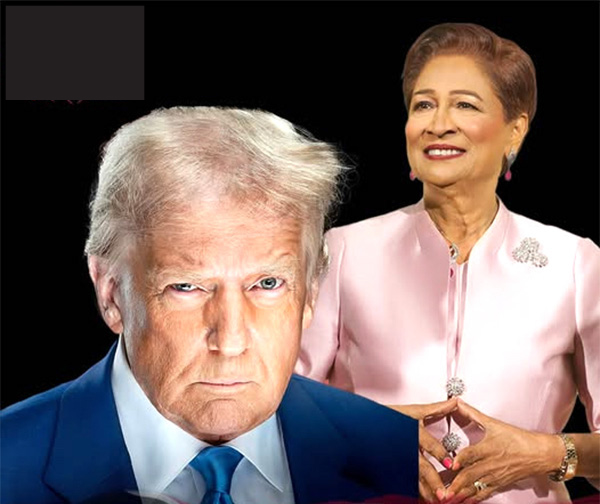



Diplomacy is often conducted in quiet corridors and carefully worded communiqués. But sometimes symbolism carries as much weight as substance. The reported invitation by United States President Donald Trump for Prime Minister Kamla Persad-Bissessar to meet with him in Florida on March 7 is one such moment. It is not merely a bilateral courtesy call; it is a signal, geopolitical, economic, and strategic.
For Trinidad and Tobago, the significance lies first in access. The United States remains this country’s largest trading partner and its most influential security counterpart. Energy exports, financial flows, and regional security cooperation all intersect with Washington.
A direct invitation from a sitting U.S. president suggests that Trinidad and Tobago is not peripheral to U.S.- Caribbean policy but central enough to warrant direct engagement at the highest level.
The timing matters because the Caribbean is navigating a volatile geopolitical landscape: tensions in the Southern Caribbean, questions of energy security, cross-border crime, and heightened global competition for influence in small states. Florida, as the chosen venue, is itself symbolically potent.
It is America’s gateway to the Caribbean, economically, politically, and demographically. A meeting there underscores the Caribbean’s strategic proximity to the United States and reinforces the idea that what happens in Port of Spain does not stay in Port of Spain.
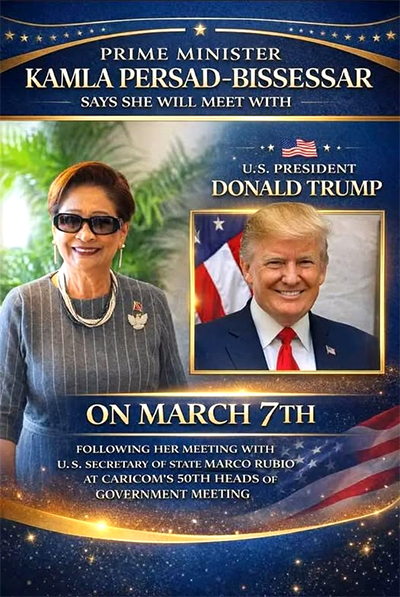
For Persad-Bissessar, the invitation represents diplomatic capital, and international legitimacy matters in domestic politics. A face-to-face engagement with the U.S. president elevates her standing not only abroad but at home.
It positions her as a leader capable of navigating major power relationships, an asset in a region where small states must balance sovereignty with pragmatism. But beyond optics, there are substantive issues likely to be on the table.
Energy will almost certainly feature prominently. Trinidad and Tobago remains a critical gas producer in the Caribbean basin, and U.S. companies have longstanding investments in the country’s energy sector.
With global markets in flux and supply chains under pressure, Washington has strong incentives to ensure stable partnerships with reliable energy suppliers. Discussions in Florida could signal deeper cooperation in LNG development, offshore exploration or regional energy integration.
Security is another pillar. The Caribbean continues to battle transnational crime, narcotics trafficking, and arms flows. The United States has repeatedly emphasised the importance of security partnerships in the hemisphere.
A high-level meeting with Trump could reinforce joint initiatives, intelligence sharing, and maritime coordination. It may also serve to align positions on broader regional flashpoints.
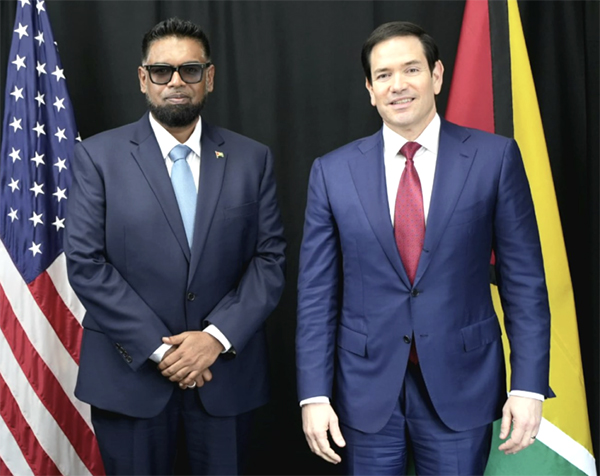
Guyana President Dr Irfaan Ali, and US Secretary of State Marco Rubio
Then there is migration and visa policy. The Caribbean’s relationship with the United States is shaped not only by trade and security but also by people.
Visa processing, travel access, and diaspora engagement are perennial concerns. Florida is home to large Caribbean communities, including a significant Trinidad and Tobago diaspora. A meeting in that state inevitably carries implications for people-to-people ties.
Political theatre
The invitation also carries a regional dimension. CARICOM has, at times, struggled to present a unified front in dealings with global powers. A direct bilateral engagement between Washington and Port of Spain could be interpreted as a sign of differentiated diplomacy, with the United States engaging selectively with individual Caribbean leaders rather than solely through multilateral frameworks.
Whether that strengthens or complicates regional cohesion depends on how the engagement is framed and communicated afterwards.
Critics may dismiss the meeting as political theatre. That would be premature. High-level engagements shape narratives and open doors for subsequent technical negotiations. They set the tone, establish priorities, and can accelerate agreements that would otherwise linger in bureaucratic limbo.
Ultimately, the significance of the March 7 meeting will not lie in the handshake or the photograph, but in what follows. Does it yield clearer energy cooperation, stronger security commitments, and improved trade facilitation, or does it fade into symbolism?
For a small state, proximity to power can be either a leverage or a liability. The measure of leadership is how effectively that proximity is managed.
President Trump’s invitation places Trinidad and Tobago at a diplomatic crossroads. What happens in Florida may very well reverberate far beyond it.
