


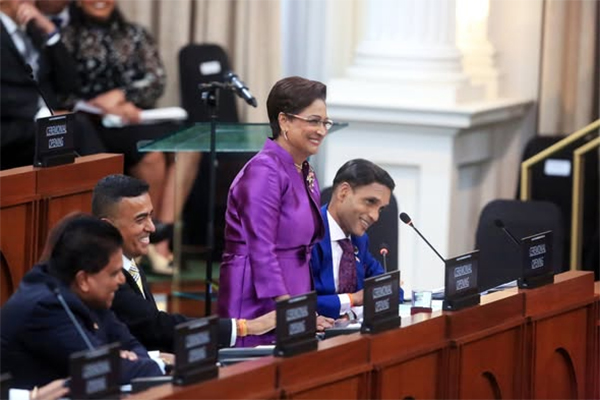



Foul-mouthed Gadsby-Dolly has taken us to a new low
By Dr Jack Austin Warner
In every society, there are moments when a single statement reveals something deeper about the health of its public life. The recent social media outburst by Gyan Gadsby-Dolly, directed at Kamla Persad-Bissessar, is one such moment. It was not merely a sharp political exchange. It was a jarring example of how far political discourse in Trinidad and Tobago has fallen.
What makes the episode particularly disheartening is that many Trinbagonians once held Gadsby-Dolly to a very different standard. She was widely known as someone raised in the disciplined and value-driven environment of the Seventh-day Adventist Church. Her family’s roots in that community are well known. Her grandfather, Samuel L. Gadsby, served as a Pastor and South Caribbean Conference President, while her uncle, Melvin Gadsby, was the Conference Youth Leader, and she herself was a familiar face in Sabbath School and Divine Hour, often singing and participating in the life of the church.
In communities shaped by faith traditions, those early experiences are expected to leave a lasting imprint, one that emphasises restraint, humility, and respect for others even in disagreement. That is why many citizens were genuinely stunned to see a politician with that background descend into language that belongs more to the roughest corners of social media than to the public life of a national leader.
Politics, of course, is not a monastery. It is a rough arena where passions run high and sharp words are often exchanged. Yet there remains a line that serious leaders understand must never be crossed. That line is the basic respect owed to opponents as fellow citizens and as human beings. When political arguments devolve into personal insults, the debate ceases to be about ideas and becomes a spectacle of contempt.
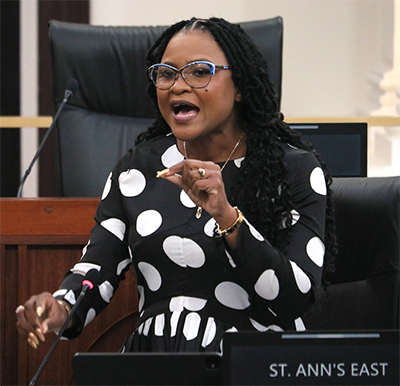
The consequences are not trivial. Public officials do not operate only as legislators or party advocates; they are also role models in a society that is constantly teaching its young people what acceptable behaviour looks like. When those entrusted with national leadership resort to crude personal attacks, the message transmitted to the next generation is unmistakable: that power excuses disrespect.
Deeply troubling
For young people watching the country’s politics unfold, this is deeply troubling. Many of them are already disillusioned with public life, seeing it as a space dominated by bitterness rather than vision. They look for leaders who embody discipline, intelligence, and dignity, people who demonstrate that disagreement can be fierce without becoming vulgar.
In that sense, the disappointment expressed by many citizens is not merely partisan. It is moral. Trinidad and Tobago is a country where religious institutions, schools, and families still labour to instill basic virtues of respect and civility. When public figures who emerged from those very institutions appear to abandon those values, the sense of betrayal can be profound.
This is why the reaction to Gadsby-Dolly’s remarks has carried such a tone of sadness rather than simple outrage. Many people did not expect this kind of language from someone once affectionately known in church circles as “Sis Gadsby-Dolly.” The contrast between that image and the tone of the recent comments could hardly be sharper.
The broader question now facing the country is whether political culture can recover some measure of dignity. Robust debate is essential in any democracy. Governments must be challenged, and opposition parties must be criticised. But there is a difference between vigorous argument and the kind of personal degradation that drags the national conversation into the gutter.
Trinidad and Tobago deserves leaders who understand that distinction. Of all people, we thought that Gadsby-Dolly was a cut above the rest, but alas!
The country’s politics will always contain fierce battles. But if those battles are to produce progress rather than cynicism, they must be conducted with a measure of restraint and respect. When that standard collapses, as it did in this episode, the damage goes far beyond a single Facebook post.
It erodes the very idea that public leadership should represent the highest, not the lowest, instincts of the society it serves.
