





By Sam Frimpong
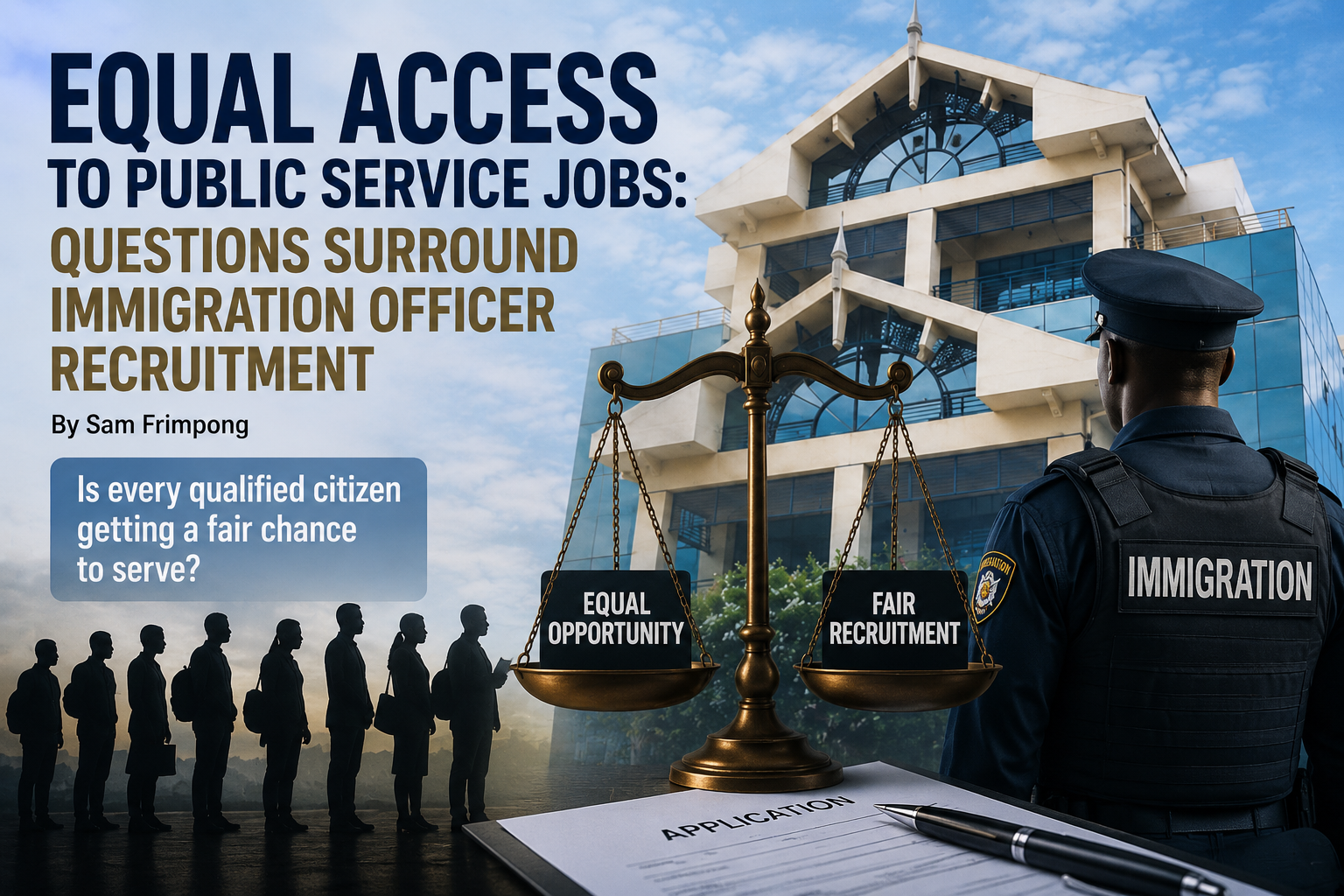
This article is not intended to condemn or criticize the Service Commissions Department (SCD). Rather, it seeks to examine whether the principles of equal opportunity and fair recruitment, as outlined in the Constitution of Trinidad and Tobago and the Equal Opportunity Act, are being consistently applied in the recruitment process for the position of Immigration Officer I.
Information published on the SCD’s website indicates that an examination for the position of Immigration Officer I was scheduled for Saturday, August 15, 2026, for eligible public officers.
The issue is not the examination itself, but the recruitment process that preceded it. Was the position advertised exclusively within the public service, or was it also advertised nationally? If it was publicly advertised, when and through which media was the announcement made? If it was not, what was the rationale behind that decision?
These are important questions because recruitment for other uniformed and protective services, including the Police Service, the Defence Force, the Prison Service and the Fire Service, has traditionally involved public advertisements that allow qualified citizens to apply.
Section 4 of the Constitution of Trinidad and Tobago recognizes, among other rights, the right to equality before the law and the right to equality of treatment by public authorities in the exercise of their functions.
Supporters of a broader recruitment process may argue that publicly advertising vacancies encourages transparency, expands the pool of applicants and increases opportunities for suitably qualified citizens, particularly recent university graduates seeking employment.
Historically, recruitment into the Immigration Division has often been viewed as more restrictive than recruitment into other public services. Whether this perception is accurate is a matter that can be clarified through greater transparency regarding recruitment policies and practices.
There is evidence that, in previous years, the position of Immigration Officer I was advertised nationally, allowing members of the public to compete for available positions. Applicants reportedly included graduates from institutions such as the College of Science, Technology and Applied Arts of Trinidad and Tobago (COSTAATT), The University of the West Indies and the University of Trinidad and Tobago, as well as nationals who pursued studies abroad.
Those applicants brought diverse academic backgrounds to the service, including qualifications in law, psychology, administration, international relations, criminal justice and foreign languages. Many continue to serve in the Immigration Division today.
If recruitment practices have changed over time, the reasons for those changes should be clearly explained. Transparency would help to address concerns about fairness and would provide clarity for prospective applicants.
Another issue that deserves consideration is the scheduling of examinations. Have accommodations been made for candidates who may be unable to sit examinations on a particular day because of religious observances or other legitimate concerns? Ensuring that recruitment processes are inclusive and accessible should remain an important consideration.
Modern immigration services operate in an increasingly complex environment shaped by migration, border security, human rights, international travel, economic migration, environmental displacement and evolving security concerns. These challenges require strategic planning and effective recruitment policies designed to attract talented and qualified candidates.
Many countries, including smaller jurisdictions, use national recruitment campaigns to attract the widest possible pool of applicants. Such an approach can strengthen institutions by bringing together individuals with different skills, experiences and areas of expertise.
Ultimately, the central question is whether the current recruitment process for Immigration Officer I provides all suitably qualified citizens with a fair opportunity to serve their country.
At a time when many graduates are struggling to secure employment, a transparent discussion about recruitment policies within the public service may be both timely and necessary. Greater openness would not only strengthen public confidence but could also help ensure that the Immigration Division continues to attract the best available talent.
