


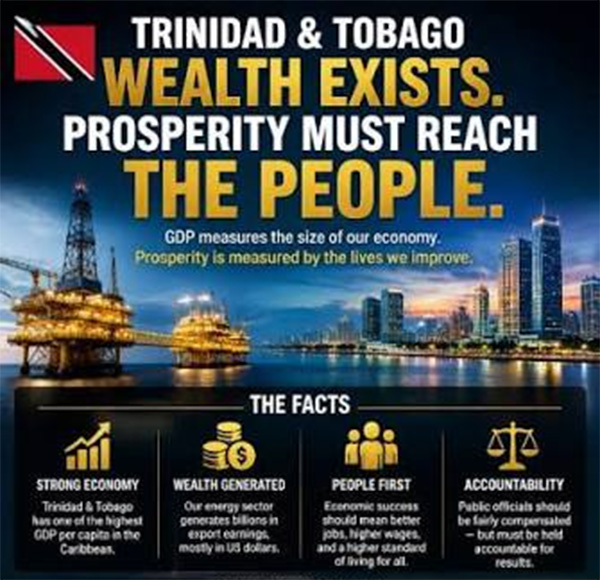



The sobering reality facing Trinidad and Tobago is that our national income can no longer comfortably support the developed lifestyle we have become accustomed to.
We cannot continue pretending that nothing has changed. The money available to the country is not unlimited, and sooner or later the arithmetic has to be faced.
Painful adjustments will therefore be necessary. But the critical questions are: Where should the adjustments be made? Who should bear the burden? And how will Government ensure that the process is fair, equitable and properly explained?
This is where the greatest danger lies.
People who are asked to give up something will inevitably look around and ask: Why me? What about them? Why should I sacrifice while someone else continues as before?
If Government cannot answer those questions convincingly, economic adjustment can quickly become a social and political problem.
The public must not be told simply that “times are difficult” while being expected to carry the burden through higher taxes, higher prices, reduced services or reduced purchasing power.
There must be visible evidence that Government itself is tightening its belt, eliminating waste, improving efficiency and making difficult choices before asking citizens to make theirs.
Most importantly, the burden cannot fall disproportionately on pensioners, working families and those least able to absorb it.
Trinidad and Tobago needs an honest national conversation about what we can afforde, and what we can no longer afford.
People can accept sacrifice when they understand the reason for it and believe that the sacrifice is being shared fairly.
But if citizens believe that the rules apply differently to different groups, resentment will grow. And when economic hardship is combined with a sense of injustice, the consequences can extend far beyond economics.
The Government’s greatest challenge is therefore not simply balancing the books. It is maintaining public confidence while doing so.
The country deserves the truth, a credible plan and, above all, fairness.
Gordon Laughlin,
Westmoorings
