


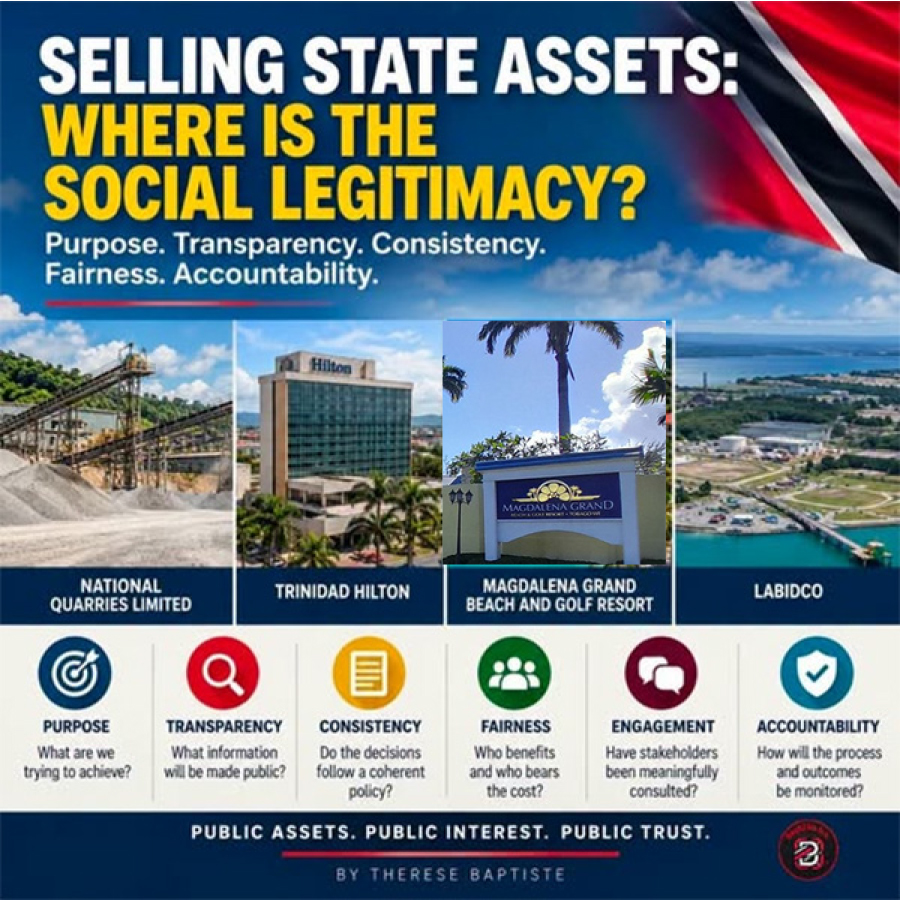



𝗦𝗧𝗔𝗧𝗘 𝗔𝗦𝗦𝗘𝗧𝗦
By Therese Baptiste
Prime Minister Kamla Persad-Bissessar has announced plans to divest National Quarries Limited, the Hilton Trinidad, the Magdalena Grand Beach and Golf Resort, and the La Brea Industrial Development Company Limited (LABIDCO).
The announcement deserves more than an argument about whether government or the private sector is better at running businesses.
It deserves a clear explanation of why these particular assets, why now, under what conditions, and for whose long-term benefit.
I am not opposed to divestment in principle.
An enterprise can be publicly owned yet privately managed; it can also be privately owned while remaining subject to public-interest obligations.
Ownership, operation and regulation are different policy choices. Through my Social Legitimacy
Framework™, the central question is whether the proposed decisions can earn and sustain public
confidence because their purpose, evidence, process and consequences are demonstrably credible and fair.
𝟭. 𝗣𝗨𝗥𝗣𝗢𝗦𝗘: 𝗪𝗛𝗔𝗧 𝗣𝗥𝗢𝗕𝗟𝗘𝗠 𝗜𝗦 𝗗𝗜𝗩𝗘𝗦𝗧𝗠𝗘𝗡𝗧 𝗜𝗡𝗧𝗘𝗡𝗗𝗘𝗗 𝗧𝗢 𝗦𝗢𝗟𝗩𝗘?

Is the Government seeking to stop recurring losses, raise immediate cash, attract new investment, improve services, reduce debt or change the State’s role in the economy?
These are different objectives and should not be presented as though they are interchangeable.
A sale that reduces an annual subsidy might be defensible even if it produces modest proceeds. A sale that generates substantial short-term revenue may be poor value if it forfeits a strategic asset or creates larger longterm costs.
The Government should publish a specific rationale and measurable objectives for each transaction.
It should also say how the proceeds would be used. Will they finance recurrent expenditure, retire debt, or fund productive investment?
Without that explanation, the public cannot judge whether divestment is a strategy or simply a response to fiscal pressure.
𝟮. 𝗘𝗩𝗜𝗗𝗘𝗡𝗖𝗘: 𝗪𝗛𝗬 𝗜𝗦 𝗦𝗔𝗟𝗘 𝗕𝗘𝗧𝗧𝗘𝗥 𝗧𝗛𝗔𝗡 𝗧𝗛𝗘 𝗔𝗟𝗧𝗘𝗥𝗡𝗔𝗧𝗜𝗩𝗘𝗦?
National Quarries offers a serious example. At a parliamentary hearing in March 2026, its chairman reported substantial losses and government subventions, alongside selling prices well below reported production costs. This plainly warrants action. But a diagnosis of financial distress does not, by itself, prescribe outright sale as the remedy.
Were the losses caused by inefficiency, governance failures, outdated equipment, deliberate belowcost pricing, or a combination of factors? If low prices were intended to support construction and infrastructure, who benefited from that policy and how was its public cost assessed? What would happen to aggregate prices, supply reliability and environmental oversight under private ownership?
A credible options appraisal should compare restructuring, professional management, partnerships, partial divestment and outright sale – not only the status quo against selling.
𝟯. 𝗖𝗢𝗡𝗦𝗜𝗦𝗧𝗘𝗡𝗖𝗬: 𝗛𝗢𝗪 𝗗𝗢 𝗧𝗛𝗘𝗦𝗘 𝗗𝗘𝗖𝗜𝗦𝗜𝗢𝗡𝗦 𝗙𝗜𝗧 𝗧𝗛𝗘 𝗣𝗢𝗟𝗜𝗖𝗬 𝗛𝗜𝗦𝗧𝗢𝗥𝗬?

The Hilton Trinidad raises an immediate question of continuity. In September 2026, the Government announced a revised arrangement through e TecK that consolidated ownership while Hilton remained the hotel operator. Now a divestment is proposed.
These steps may be compatible: the restructuring could have prepared the asset for a different long-term model. But if so, explain the sequence, the cost, the rationale and what has changed. A recent ownership decision and a subsequent sale announcement should form a coherent narrative, not leave the public to invent one.
There is also institutional history at Magdalena Grand. Expressions of interest covering management, investment and possible outright purchase were sought in 2022. What became of that process?
Why did it not deliver the intended result, and what will be different this time? Sound policymaking acknowledges earlier attempts, evaluates their outcomes and demonstrates what has been learned- regardless of which political administration initiated them.
𝟰. 𝗦𝗧𝗥𝗔𝗧𝗘𝗚𝗜𝗖 𝗩𝗔𝗟𝗨𝗘: 𝗧𝗛𝗘𝗦𝗘 𝗔𝗥𝗘 𝗡𝗢𝗧 𝗙𝗢𝗨𝗥 𝗜𝗡𝗧𝗘𝗥𝗖𝗛𝗔𝗡𝗚𝗘𝗔𝗕𝗟𝗘 𝗔𝗦𝗦𝗘𝗧𝗦
Hotels, quarries and industrial-port infrastructure do not pose identical public-interest questions. The value of a hotel depends heavily on its condition, demand, branding, investment needs and operating performance.
For Magdalena, tourism development in Tobago must also be assessed against local employment, supply chains, accessibility, community interests and the role of the Tobago House of Assembly.
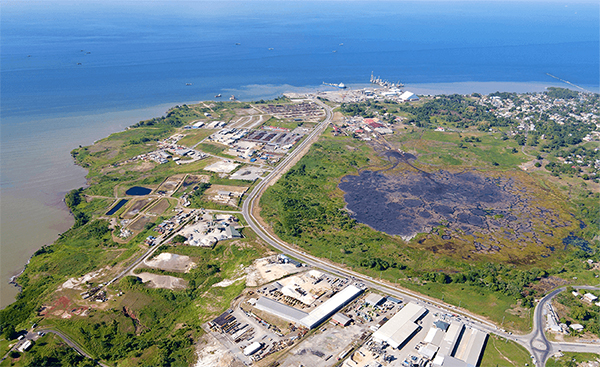
LABIDCO requires particular clarity. The company develops and manages the La Brea Industrial Estate and associated maritime facilities. Does “divestment” mean selling shares in the company,
transferring ownership of land and port infrastructure, offering a concession, or inviting an operating partner?
What happens to strategic access, national industrial-development objectives, future
investment opportunities and environmental obligations? A sale of commercial operations is not necessarily the same as surrendering control of a strategic asset.
𝟱. 𝗧𝗥𝗔𝗡𝗦𝗣𝗔𝗥𝗘𝗡𝗖𝗬 𝗔𝗡𝗗 𝗣𝗥𝗢𝗖𝗘𝗗𝗨𝗥𝗔𝗟 𝗜𝗡𝗧𝗘𝗚𝗥𝗜𝗧𝗬: 𝗛𝗢𝗪 𝗪𝗜𝗟𝗟 𝗗𝗘𝗖𝗜𝗦𝗜𝗢𝗡𝗦 𝗕𝗘 𝗠𝗔𝗗𝗘?
Citizens should not learn the full meaning of a public asset sale only after a preferred buyer has emerged. Before binding commitments are made, the Government should disclose the transaction model; independent valuations; material liabilities; the selection criteria; the expected public benefits; and the protections governing land, labour, the environment and future service delivery.
Commercially sensitive information may require careful handling, but confidentiality cannot become a blanket justification for withholding the basis of a public decision.
Expressions of interest should lead to a genuinely competitive and independently governed process.
There should be clear conflict-of-interest rules, scrutiny of ultimate beneficial ownership and
safeguards against favouritism. The public also deserves to know who is empowered to approve a sale and what institutional checks apply.
𝟲. 𝗣𝗔𝗥𝗧𝗜𝗖𝗜𝗣𝗔𝗧𝗜𝗢𝗡 𝗔𝗡𝗗 𝗙𝗔𝗜𝗥𝗡𝗘𝗦𝗦: 𝗪𝗛𝗢 𝗛𝗔𝗦 𝗔 𝗩𝗢𝗜𝗖𝗘, 𝗔𝗡𝗗 𝗪𝗛𝗢 𝗖𝗔𝗥𝗥𝗜𝗘𝗦 𝗧𝗛𝗘 𝗥𝗜𝗦𝗞?
Employees, trade unions, host communities, local businesses, tourism stakeholders, environmental interests and relevant public institutions are not obstacles to an efficient process.
They are people and organisations that will live with its consequences. Their input can reveal risks that do not appear on a balance sheet.
Consultation should begin while meaningful options remain open, not after the decision is effectively irreversible.
What protections are proposed for jobs, pensions and other accrued entitlements? Will small local suppliers retain access?
Will communities experience environmental or infrastructure costs while benefits accrue elsewhere?
In Tobago, how will local development priorities and representative institutions be engaged?
Fairness requires an honest account of who benefits, who pays and what mitigation is promised.
𝟳. 𝗔𝗖𝗖𝗢𝗨𝗡𝗧𝗔𝗕𝗜𝗟𝗜𝗧𝗬: 𝗛𝗢𝗪 𝗪𝗜𝗟𝗟 𝗪𝗘 𝗞𝗡𝗢𝗪 𝗜𝗙 𝗧𝗛𝗘 𝗣𝗨𝗕𝗟𝗜𝗖 𝗕𝗘𝗡𝗘𝗙𝗜𝗧𝗘𝗗?
Social legitimacy cannot be secured with a press release or a successful closing ceremony. Before divestment, the Government should identify the outcomes it expects and commit to publishing results afterward.
These might include net proceeds after transaction costs and liabilities, investment
actually delivered, employment commitments honoured, service performance, environmental
compliance and any continuing fiscal exposure.
Sale agreements should provide credible monitoring and enforcement mechanisms, including
consequences where promised investment or other material commitments are not fulfilled.
Ministers and responsible institutions should be able to explain not just the price received, but the public value created or lost.
The right to make a decision is not the same as earning public confidence in that
decision.
𝗧𝗛𝗘 𝗦𝗢𝗖𝗜𝗔𝗟 𝗟𝗘𝗚𝗜𝗧𝗜𝗠𝗔𝗖𝗬 𝗧𝗘𝗦𝗧
The Government may ultimately make a strong case for divesting one, several or all of these assets.
Equally, proper examination may support different solutions for different enterprises. That is precisely why the justification must precede the conclusion.
My Social Legitimacy Framework™ asks that public decisions demonstrate clarity of purpose,
consistency between words and actions, transparency of evidence and process, fairness in the distribution of benefits and burdens, meaningful stakeholder engagement, and accountability for outcomes.
None of these requirements is anti-investment. They are conditions for investment and reform that the public can trust.
Public assets should not be sold simply because the State can sell them. They should be
divested only when the public can see why the decision makes sense, how it was reached, and
how Trinidad and Tobago will be better off.
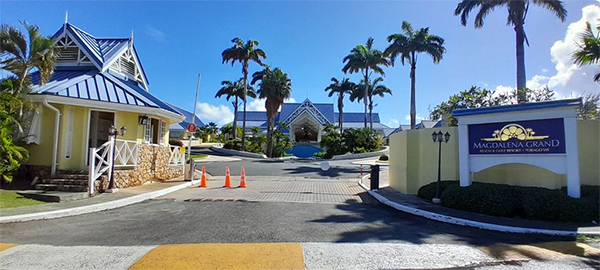
The Magdalena Grand Beach and Golf Resort in Tobago is one of the State assets Government is looking to sell off.
