





By Corneilus George
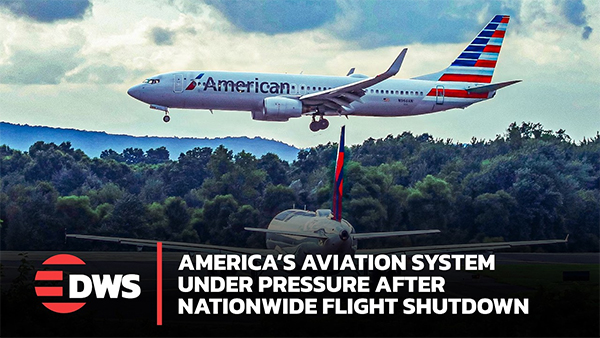
America’s unprecedented aviation disruption on November 13, 2026, has raised troubling questions about the reliability of critical national infrastructure, the rapid introduction of artificial intelligence and the security threats confronting the United States.
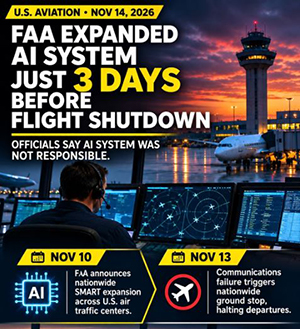
The Federal Aviation Administration’s (FAA) nationwide ground stop came just three days after it announced the expansion of its new artificial intelligence-assisted system, SMART, across all 22 air traffic control centres.
It also occurred within days of renewed Iranian threats against American military installations.
The coincidence raises an unavoidable question: Why did America’s ageing aviation communications infrastructure fail at precisely this moment?
Was the breakdown an unfortunate technological failure, a consequence of integrating modern systems with outdated equipment, or could external interference have played some role?
There is currently no verified evidence connecting Iran to the disruption, and federal officials have identified overloaded legacy communications equipment as the apparent cause. Nevertheless, the sequence deserves careful examination.
On November 10, the FAA announced the nationwide expansion of SMART (Strategic Management of Airspace, Routes and Trajectories) following its initial deployment in the Washington region.
The cloud-based system uses about 200 data streams, including weather, flight schedules, and traffic patterns, to help aviation specialists manage American airspace. Its purpose is to improve efficiency, reduce delays and strengthen operational decision-making.
Three days later, the FAA experienced serious instability affecting radar information and communications between aircraft and air traffic controllers. The consequences were immediate.
Departures across the United States were halted for approximately four hours, according to FlightAware figures reported by ABC News; more than 12,500 flights were disrupted across November 13 and 14, and travellers faced widespread uncertainty.

Transportation Secretary Sean Duffy attributed the failure to overloaded switches and routers within an ageing telecommunications network. Homeland Security Secretary Markwayne Mullin suggested that newer technology being introduced into the FAA’s infrastructure had overwhelmed older systems.
That explanation raises an important engineering question.
Can modern digital technology be safely integrated into ageing national infrastructure without creating unexpected system-wide vulnerabilities? The SMART rollout naturally attracted scrutiny because of its timing.
However, Duffy stated that SMART was not connected to the critical radar-processing systems implicated in the disruption. Its developer, Air Space Intelligence, also denied that its technology caused the shutdown. Those explanations must be taken seriously. There is no established evidence that SMART triggered the failure.
But the FAA should publish sufficient technical findings to explain whether the broader modernisation programme contributed to network overload, how the failure spread nationally and why existing safeguards proved inadequate.
The distinction between SMART itself and other technology upgrades is essential. A modernisation programme can encounter serious integration problems without its artificial intelligence components being responsible.
The other troubling consideration is Iran.

On November 11, senior Iranian security official Mohsen Rezaei warned that American military installations could face retaliation if Washington launched renewed attacks against Iran.
The threats emerged amid heightened tensions between Tehran and the Trump administration. Within approximately 48 hours, America’s aviation system suffered an extraordinary disruption. Does that timing establish Iranian involvement? Absolutely not.
Iran’s warnings primarily concerned military targets, not civilian aviation. American officials reported no evidence linking the FAA incident to Iranian activity or any other foreign cyberattack. Yet the episode illustrates why critical infrastructure must be protected against both accidental failures and deliberate interference.
Modern cyberwarfare can target communications networks, transportation systems, financial institutions and energy infrastructure without the conventional warning signs of military confrontation.
A technical breakdown and a cyberattack may produce similar operational consequences, even though their causes are fundamentally different. That makes transparent investigation indispensable.
President Donald Trump’s administration should establish exactly what failed, identify whether modernisation contributed to the overload, disclose whether cybersecurity investigators found any evidence of unauthorised interference, and be honest about it.
Congress should also examine the resilience of America’s aviation infrastructure and the safeguards governing major technology deployments. The answers matter beyond Washington.
Trinidad and Tobago and other Caribbean countries depend heavily on American aviation, financial networks and telecommunications. Disruption in the United States can quickly affect regional travel, commerce and essential services.
The lesson is therefore not simply about SMART, Iran or the FAA. It concerns the vulnerability of nations increasingly dependent on complex digital systems while older infrastructure remains operational.
The most important question is not whether Iran should be blamed without evidence. It should not. Nor should SMART be condemned merely because its nationwide expansion preceded the shutdown.
The question is why an ageing communications network failed so extensively during a major technological transition and at a moment of heightened international tension. Washington’s preliminary exclamation points to infrastructure failure, not foreign sabotage, but that finding should be supported by a comprehensive, publicly accountable investigation.
America must establish whether its aviation shutdown was an isolated equipment failure, a warning about the risks of modernising critical infrastructure without sufficient resilience or something more sinister.
In an increasingly unstable world, the consequences of failing to answer that question could extend far beyond delayed flights.
