





By Ken Ali
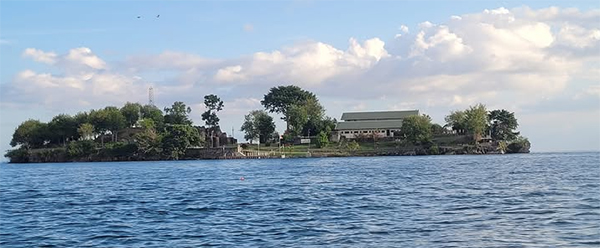
No other small piece of Trinidad and Tobago land bears as much of our chequered history as Nelson Island, which is just over four acres in size.
As someone long fascinated by the history of the largest of our five islands, I am interested in Prime Minister Kamla Persad-Bissessar’s announced plans to rename the area.
The Prime Minister made the revelation Saturday while hosting India’s External Affairs Minister Subrahmanyam Jaishankar at a function on the island.
Conventional wisdom is that Indian indentured immigrants landed at the island, which served as a quarantine station.
But that’s a mere part of the island’s long and colourful past.
About 114,000 immigrants arrived from 1866 until 1917, when indentureship was scrapped because shipping vessels were required during World War 1.
Some 30,000 disembarked at the Port of Spain port between 1845 and 1866.
The island was also used to process the roughly 13,000 labourers who returned to India after their five-year indentureship.
Nelson Island – once dubbed Ellis Island, after the US’ gateway for immigrants – was also an arrival port for Portuguese, Mandarin and Chinese workers.
On April 21, 1970, when Prime Minister Dr. Eric Williams declared a State of Emergency to zap Black Power demonstrations, up to 100 leaders and activists were jailed at Nelson Island.
The leaders, including Makandal Daaga (then Geddes Granger), George Weekes, Khafra Kambon, and my longstanding friend, Clive Nunez, were slapped with sedition charges.
Williams was running for cover as many turned on his administration for a chronic lack of economic opportunities.
The funeral of protestor Basil Davis – who was shot at point-blank range by a policeman – attracted tens of thousands of agitated mourners.
Williams tried to suppress protests, by, among other measures, a planned Public Order Act, a draconian legislation of Attorney General Karl Hudson-Phillips.
Remember Chalkdust’s “Ah ‘Fraid Karl”?
Tubal Uriah “Buzz” Butler, the dominant leader of Fyzabad’s oil workers, was jailed on the island by colonial authorities for a period in 1936 and 1937 on sedition and treason charges.
Butler was also detained for the six years of World War 11, beginning in 1939.
His image was restored after colonialism, and he was awarded the country’s highest honour.
Many years earlier, the landmass was a Spanish fortress named Stephenson Island.
Later, under British rule, it became Nelson Island, named after the Brirish war hero, Admiral Horatio Nelson and, was a venue for upper class parties.
From an entertainment zone for the elite, to a first-stop medical centre for immigrants, to a detention location for working class heroes, Nelson Island has a singular history.
The Prime Minister’s mission and Minister Jaishankar’s visit throw a fresh spotlight on the island’s unique past.
The current challenge is to settle on a name that effectively captures that saga.
