


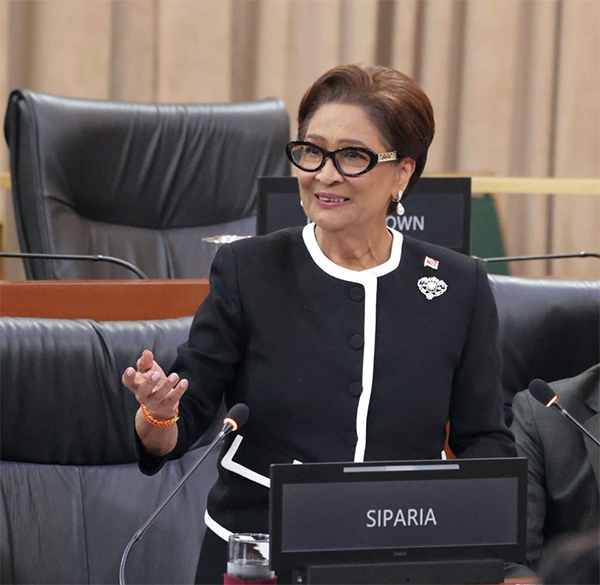



to declare State of Emergency in 2011.
Press Release
Today, at 9:15a.m. the Judicial Committee of the Privy Council delivered judgement in the Appeals of Dominic Pitilal, Earl Elie and Ashmeed Mohammed v The Attorney General of Trinidad and Tobago, dismissing the Appeals brought by the Appellants. The Appellants in these appeals challenged the constitutionality of the declaration of a ‘limited State of Emergency’ by Prime Minister Kamla Persad-Bissessar made on the 21st August 2011 and the validity of the Emergency Powers Regulations 2011.
That State of Emergency was declared in response to the unprecedented escalation of murders and other serious acts of violence and lawlessness occurring at the time, including a plot to assassinate the Prime Minister.
The Prime Minister acted to secure public safety and restore law and order. The Privy Council noted that the evidence showed that there had been “a threat to the life of the nation in a very literal way”. The decision today vindicates the decision of the Prime Minister and her government.
The Privy Council recognised that its decision in these appeals had ‘important implications for the more recent states of emergency declared by the Government’ including those declared in July 2025 and March 2026 as the circumstances were similar and the Emergency Powers Regulations enacted were materially the same as those enacted in 2011 that were a mirror image of those enacted in 1990.

This decision reaffirms the cardinal principle that the decision whether a public emergency exists is primarily a decision for the executive, with the approval of Parliament, in respect of which the courts will accord due weight to the judgment of the executive and the legislature. In determining any challenge to these decisions, the Court is to afford considerable weight to the assessment of the executive and senior members of the security and police services who are tasked with gathering and assessing threats and risk to public safety.
The importance of this judgment is that it recognises the heavy responsibility that is placed upon elected officials, who are accountable to the citizenry, in exercise of powers that are conferred by the Constitution to protect public safety and our democracy in the most challenging times.
In these difficult times a Government is required to act upon information and intelligence that is not and sometimes cannot be made public or be included in statements made to the House of Representatives.
This Government will act in the best interest of our country to uphold the rule of law and to protect the democracy that we enjoy as a people.
This decision confirms that in times of Emergency, when our democracy is tested, your Government has the responsibility and power under the Constitution to take all steps that are necessary to guarantee public safety, and to protect our citizens.
This Government now commits to supporting under the Constitution all actions taken by the Security forces to stabilize and secure the lives of the law abiding citizens of Trinidad.
We welcome this decision of the Privy Council and trust that it shall be given appropriate respect by all stakeholders in the Justice system.
