





By Dr Jack Austin Warner
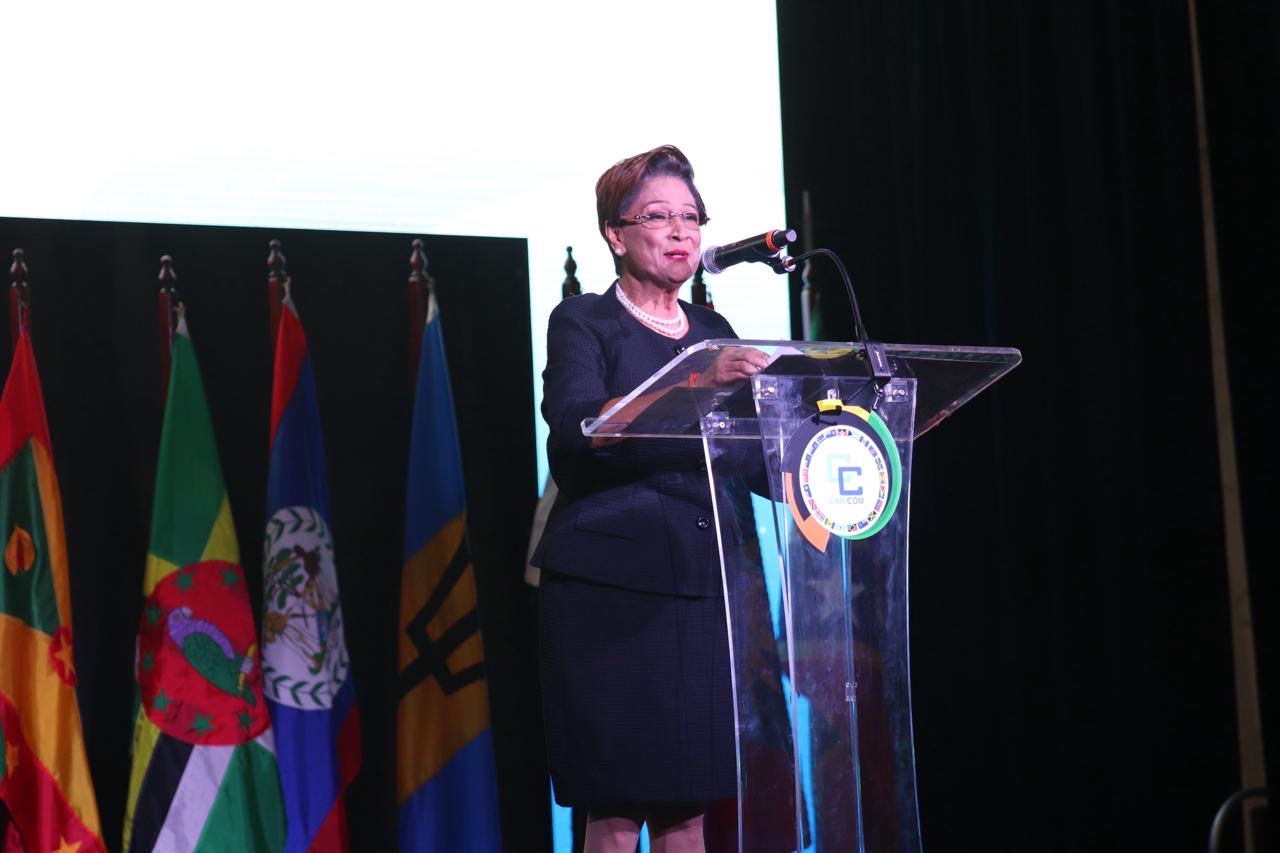
When Kamla Persad-Bissessar addressed leaders at the opening of the 50th Regular Meeting of the Conference of Heads of Government of the Caribbean Community in Basseterre, her remarks came at a time when the Caribbean faces converging pressures: economic volatility, climate vulnerability, crime spillovers, and geopolitical realignment.
Her position, as articulated during the ceremony, underscored a simple but urgent theme: regional unity must move beyond rhetoric and translate into coordinated action.
The Caribbean arrived at its 50th CARICOM meeting not as a bloc at ease, but as a region navigating structural challenges. Global inflationary shocks have strained small economies, climate events have grown more intense and frequent, transnational crime networks exploit maritime corridors, and energy transitions are reshaping traditional revenue models. In this context, Persad-Bissessar’s emphasis on solidarity and strategic cooperation was less ceremonial than necessary.
She framed the moment as one demanding pragmatic integration. For small island and coastal states, fragmentation is costly. Trade within CARICOM remains underdeveloped relative to its potential. Regulatory harmonisation proceeds slowly. Supply chains remain externally dependent. Her call for deeper economic collaboration was a reminder that resilience requires internal strengthening, not merely external negotiation.
Security, too, loomed large. The Caribbean’s geographic position places it along key trafficking routes linking South America to North American and European markets. Persad-Bissessar’s acknowledgement of shared security vulnerabilities reflects a recognition that crime is no longer purely domestic. Intelligence sharing, maritime coordination, and joint policy responses are indispensable if the region is to prevent isolated hotspots from metastasising into systemic instability.
At the same time, her address implicitly navigated the region’s delicate geopolitical environment. The Caribbean finds itself courted by multiple global powers, each offering investment, security cooperation, or development financing. Strategic engagement is essential, but so is sovereignty. Her tone suggested that CARICOM must engage externally from a position of collective strength, not fragmented bilateralism. A unified regional voice enhances negotiating leverage and preserves policy independence.
Energy and economic transformation also formed part of the broader regional conversation. For hydrocarbon-producing states like Trinidad and Tobago, the global energy transition presents both risk and opportunity. For tourism-dependent economies, sustainability and resilience remain existential concerns. Persad-Bissessar’s remarks signalled the need for adaptive strategies, embracing innovation, digital transformation, renewable energy exploration, and diversified trade relationships without abandoning economic realities.
Importantly, her address carried symbolic weight. The 50th meeting is not merely a procedural milestone; it marks half a century of regional aspiration. CARICOM was founded on the premise that shared history, geography, and economic interests could produce collective strength. Yet progress has often been incremental. By invoking renewed commitment, Persad-Bissessar aligned herself with a broader regional call for implementation over aspiration.
The Caribbean cannot afford to treat integration as ceremonial. Food security, for example, demands coordinated agricultural investment and reduced import dependence. Disaster response requires shared logistics and rapid deployment frameworks. Digital modernisation benefits from common standards and pooled expertise. Each of these areas transforms unity from slogan into strategy.
Critics may argue that such addresses are customary, with leaders speaking of cooperation as cameras roll. But context matters. With climate financing debates intensifying, global supply chains uncertain, and security challenges mounting, the tone of leadership matters. Signals sent from a CARICOM podium reverberate across markets, diplomatic circles, and domestic constituencies.
Persad-Bissessar’s stance in Basseterre suggested a recognition that regionalism is not optional for small states navigating a turbulent global order. It is a protective architecture. The Caribbean’s vulnerabilities are shared; so too must be its solutions.
The challenge now lies beyond speeches. Implementation, accountability, and measurable progress will determine whether the 50th Regular Meeting becomes a commemorative event or a turning point.
For CARICOM at 50, unity must no longer be aspirational. It must be operational.
