





BY FRANCIS JOSEPH
The Judicial Committee of the Privy Council has cleared a medical doctor of negligence.In a 23-page judgment delivered on Friday, Dr Marwan Ahmad Alsayed Abdulla successfully defended the medical negligence suit brought by Shelly Ann Balwah, on behalf of her son, Aeden Balwah.The case was argued in July before Lord Lloyd-Jones, Lord Stephens, Lord Doherty, Lady Wise, and Lord Burnett.
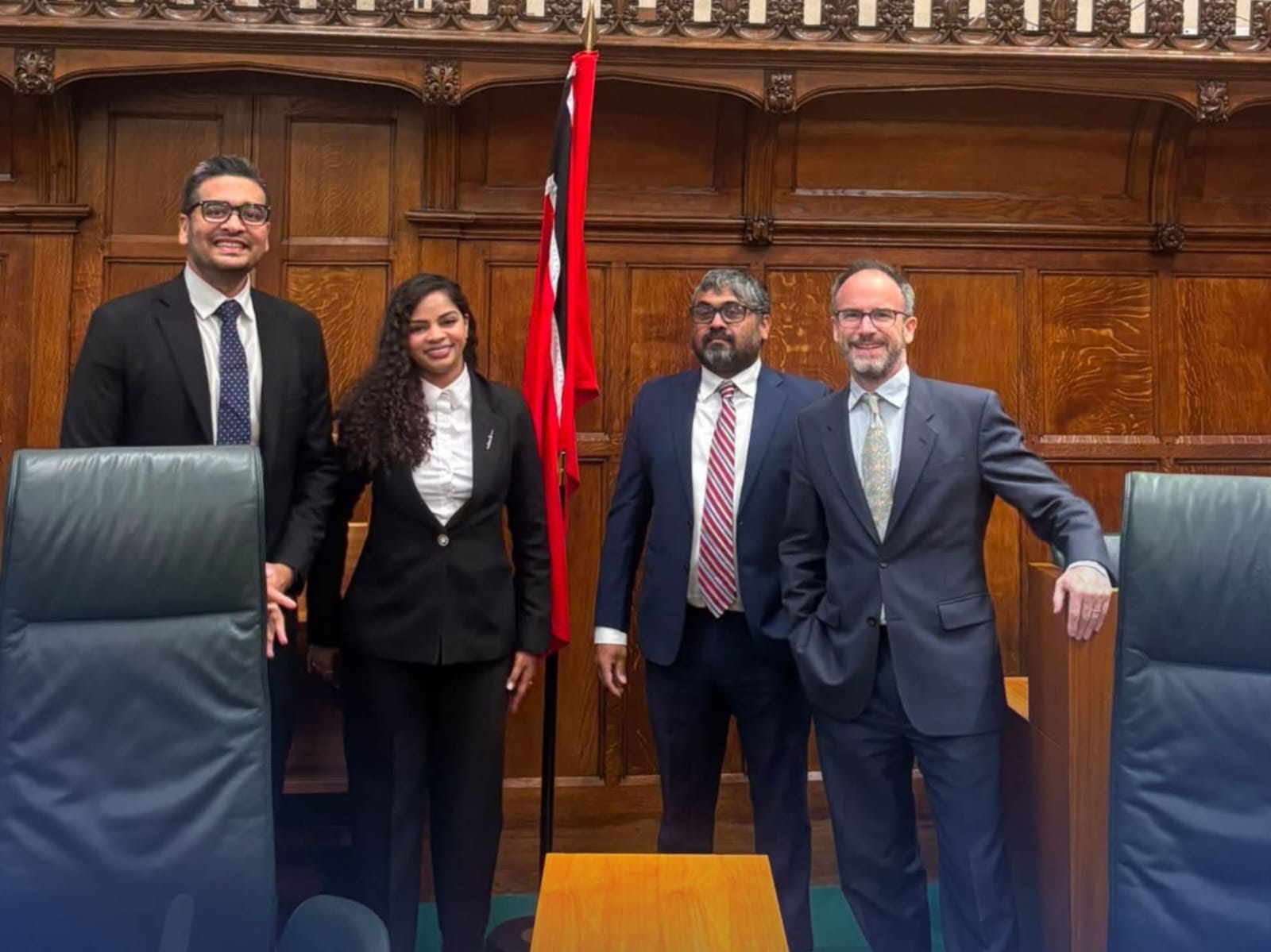
English attorney Robert Strang led the team for Dr Abdulla, along with Kiel Taklalsingh and Stefan Ramkissoon. Dr Michael Powers KC led Rajiv Persad SC, Ricardo Williams and Niala Narine for Balwah.
THE APPEAL
There were two appeals before the Privy Council. They involved proceedings for medical negligence brought on behalf of Aeden, a young man now aged 24 who has cerebral palsy, by his mother Shelly-Ann against a private hospital, Surgi-Med Clinic Co Ltd and a private medical practitioner, Dr Abdulla.
Aeden was born at Surgi-Med and Dr Abdulla delivered him. Both Surgi-Med and Dr Abdulla succeeded in resisting Aeden’s claim in the High Court. Aeden appealed against that decision to the Court of Appeal. That was successful to the extent that negligence on Dr Abdulla’s part was found established.
Aeden’s appeal against Surgi-Med was unsuccessful. Dr Abdulla appealed to the Board to overturn the finding of negligence made against him. Aeden appealed against the Court of Appeal’s decision to uphold the High Court’s ruling that he had failed to prove his case against Surgi-Med.
Surgi-Med cross-appealed to address matters in the event of Aeden successfully defending Dr Abdulla’s appeal. In general terms, the appeals concerned
(i) the extent to which it is proper for an appellate court to interfere with primary findings of fact made by a first instance judge and;
(ii) the correct approach to the admissibility of evidence contrary to a party’s written case and without amendment of that case.
THE EVIDENCE
Shelly-Ann was a private patient of Dr Abdulla during her pregnancy with Aeden, her first child. Her pregnancy ran beyond term, and she and Dr Abdulla agreed that she would be admitted to hospital for induction of labour. She was admitted to Surgi-Med for that purpose at about 6.30 pm on the 18th of May 2002 when she was one day short of 41 weeks’ gestation. At the material time Dr Abdulla was a self-employed medical practitioner who used Surgi-Med’s facilities, which included an operating theatre and delivery room. Surgi-Med employed nurses who carried out instructions given to them by attending physicians such as Dr Abdulla. Following Shelly-Ann’s admission on the 18th of May 2002, Dr Abdulla attended her. At around 8 pm, he inserted a 200-mcg tablet of misoprostol to soften the cervix and expedite the onset of labour. He then left her in the care of nurses employed by Surgi-Med. There was no foetal monitoring between 8 pm on the 18th of May and about 12.30 am on the 19th of May by those nurses. At 2.15 am on the 19th of May, Shelly-Ann reported suffering pain and nurses at the hospital called Dr Abdulla, who prescribed appropriate pain relief, a drug known as Trabilin (tramadol). While the specific time at which relevant events occurred thereafter became central to the outcome of the litigation, Shelly-Ann’s membranes ruptured at either 3 am or 3.30 am and Dr Abdulla was subsequently called to attend. He arrived at the hospital at 4 am, shortly thereafter, or at 4.30 am. He confirmed that Shelly-Ann’s cervix was fully dilated and so in second stage labour. Vaginal delivery was attempted for an hour but was unsuccessful. An episiotomy was executed in anticipation of delivery. Intermittent foetal heart rate monitoring was carried out by a nurse using a handheld Doppler device. No irregular heart rate was measured. At the end of the one-hour period a decision was taken to perform an emergency caesarean section and Dr Abdulla delivered Aeden at 6.15 am on the 19th of May. Immediately after birth, Aeden’s Apgar scores were recorded. Apgar is an acronym of appearance, pulse, grimace, activity and respiratory function, all measured to assess a newborn’s health. Each of the five markers can achieve a maximum score of 2 and are added together for a total score. Aeden’s scores were 1 after one minute and 5 after three minutes, in contrast with an expected Apgar score following birth by caesarean section of 10 at one minute. He required resuscitation by suction and a handheld breathing bag. Aeden was transported to the San Fernando General Hospital, in his father’s vehicle. A note from Dr Raymond Aguilar, a paediatrician who had attended the birth and treated Aeden immediately thereafter accompanied his admission.Over the course of the following week, Aeden continued to suffer seizures and distressed breathing in hospital. A CT scan of his brain performed at 19 days (6 June 2002), was contemporaneously interpreted, wrongly, as normal. Following further investigation and monitoring, Aeden was diagnosed with spastic cerebral palsy, developmental delays, microcephaly and seizure disorder. The CT scan was ultimately reviewed and it was agreed by the parties’ experts at trial to show abnormalities. Due to insufficient quality of the imaging, the experts were unable to agree on the specific abnormalities exhibited. Aeden continued to suffer from severe intellectual and cognitive impairment and epilepsy.

In the High Court, Shelly-Ann brought proceedings for Aeden against Surgi-Med, Dr Abdulla and Dr Aguilar in May 2013, claiming that Aeden’s cerebral palsy was the result of a hypoxic ischaemic brain injury during labour. Dr Aguilar was subsequently released from the action. During the procedural journey of the litigation various amendments to the written pleadings were made. The pleaded position of all parties on the issue of the timing of Shelly-Ann’s labour was relevant to the issues remaining in contention before the Board. At para 17(g) of his initial Statement of Case, Aeden narrated that Dr Abdulla arrived at the hospital at approximately 4 am on the 19th of May 2002 and that Shelly-Ann was taken to the delivery room. Para 17(h) stated that between 4 am and 5 am that day vaginal delivery was attempted without success. Those two paragraphs were admitted in a Joint Statement of Defence by Surgi-Med, Dr Abdulla and Dr Aguilar. In response to Aeden’s amendments, Surgi-Med and Dr Abdulla filed separate defences, in March and April 2016 respectively. Both sets of defences admitted the averments about the time of arrival of Dr Abdulla and attempts at delivery. However, Dr Abdulla also averred that he was summoned when Shelly-Ann’s cervix was fully dilated at 4.30 am and that between 4.30 am and the time of the caesarean section, the midwife monitored the foetal heart rate in his presence every five to ten minutes.
Dr Abdulla stated that he arrived there at 4.30 am and examined his patient who was fully dilated with moderate to severe contractions. At 5.30 am the decision was made to perform a caesarean section due to a failure to progress during the second stage of labour. 10.
The case went to trial before Justice Kevin Ramcharan in March 2019.
The judge concluded: “In the circumstances, the claimant’s case must be dismissed, it is not necessary for me to take the further step and consider further whether the breaches of … duty actually caused the damage, as it is not possible for them to have done so.”
Aeden appealed the trial judge’s decision to the Court of Appeal, which heard the appeal on the 21st of July 2023 and issued a decision on the 30th of July 2024, allowing the appeal in respect of Dr Abdulla and entering judgment against him, remitting the issue of damages to be determined by a Master in Chambers. The appeal was heard before Justices Mira Dean-Armorer, Vasheist Kokaram, and Malcolm Holdip,
At the Privy Council, the Law Lords ruled for Dr Abdulla, clearing him of medical negligence.
