






By Peter Green
There are moments in political life when stature is tested, not by applause, but by discomfort. For many across the Caribbean, Prime Minister Mia Mottley has long embodied decisive leadership, intellectual clarity, and regional gravitas. She has been a commanding voice on climate justice, debt reform, and global equity.
She has spoken with moral authority on behalf of small states. Her presence on the world stage has elevated Barbados and, by extension, the region, but leadership is not measured only in global fora. It is also measured in moments of institutional strain.
The exchange surrounding the Brent Thomas matter may well be remembered as the day Mia Mottley’s shine dimmed, not because of a disagreement between prime ministers, but because of what it revealed about accountability within CARICOM.
The facts are not in dispute. A Trinidad and Tobago national was arrested in Barbados and transported back to Trinidad without formal extradition proceedings. A High Court later ruled the action an “unlawful abduction.” Both governments accepted liability for constitutional breaches. That is not diplomatic gossip. That is a judicial finding.
The regional conversation at CARICOM 50, however, quickly shifted to language. Was it “kidnapping”? Was the term defamatory, or was it politically inflammatory? But when the emphasis moves from constitutional breach to semantic offence, something is lost.
In her response, Prime Minister Mottley firmly rejected the term “kidnapping,” describing it as a scurrilous lie. She emphasised that arrest warrants were presented and acted upon and that Barbados’ Cabinet was unaware of operational details.
She pointed to longstanding informal regional practices and acknowledged the need for legislative reform to operationalise the CARICOM Arrest Warrant system. Those are important clarifications, Prime Minister Mottley, but they do not fully answer the deeper concern.

Businessman Brent Thomas
If a court ruled the action unlawful, and if constitutional rights were breached, then the central issue is not whether a word was too strong. The central issue is how a regional integration framework, now over 50 years old, allowed such a breach to occur in the first place.
The CARICOM Arrest Warrant Treaty has been in force regionally since 2018. Yet its domestic implementation remains uneven across member states. Ratification without enactment is symbolism without structure. A community that speaks of harmonisation must ensure that its legal architecture functions seamlessly across borders.
When Prime Minister Mottley said that her Cabinet “knew nothing” about the operational matter, it may have been factually accurate. However, institutional leadership requires more than distance from error; it requires ownership of systemic weakness. Informal practice is not a substitute for codified law, as any learned attorney would know. And if informal arrangements led to constitutional violations, then those arrangements were inadequate.
The Caribbean does not need perfect leaders
The disappointment felt by some is not rooted in partisan alignment. It is rooted in expectation. Mia Mottley has been seen as a reformer, a regional standard-bearer, and a leader capable of moving the Caribbean from rhetoric to disciplined execution. When such a leader appears more defensive than transformative, it jars.
This was an opportunity to confront CARICOM’s implementation gap head-on and declare that informal cross-border arrest practices are unacceptable, that full legislative harmonisation will be accelerated, and that the era of administrative ambiguity is over. Instead, Mottley’s response became one of tone.
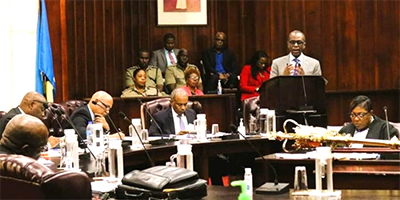
The CARICOM Arrest Warrant Treaty Bill gives domestic effect to the treaty signed by CARICOM member states on July 6, 2017, establishing a common system for the arrest and surrender of individuals wanted for prosecution or to serve custodial sentences across the region
Leadership shine does not disappear overnight. It dims when expectation meets evasion. It dims when structural flaws are acknowledged but not urgently remedied. It dims when the region’s most respected voices sound reactive rather than reformist.
The Caribbean does not need perfect leaders. It needs accountable institutions. But when leaders of stature encounter institutional failure, they must rise above personal rebuttal and convert criticism into reform.
The Brent Thomas episode was more than a diplomatic skirmish. It was a test of whether CARICOM’s legal integration is real or rhetorical. It was a moment to move decisively from informal practice to an enforceable framework.
Mia’s shine did not fade because of disagreement. It faded because the moment called for structural candour, but received defensiveness. This episode should not have been reduced to a quarrel between leaders.
Persad Bissessar’s speech should have triggered a serious audit of CARICOM’s implementation gap. Treaties must move from ratification to operationalisation. Regional law enforcement cooperation must move from convention to codification.
Mottley would agree that if CARICOM fails to make that change, it risks proving its critics right: that it excels at declarations but falters at execution. And trust, once fractured, is far harder to restore than reputation.
Prime Minister Mottley should know that in regional leadership, moral authority is hard-earned. It must be protected not only abroad but also at home. We all expected better from her.
