


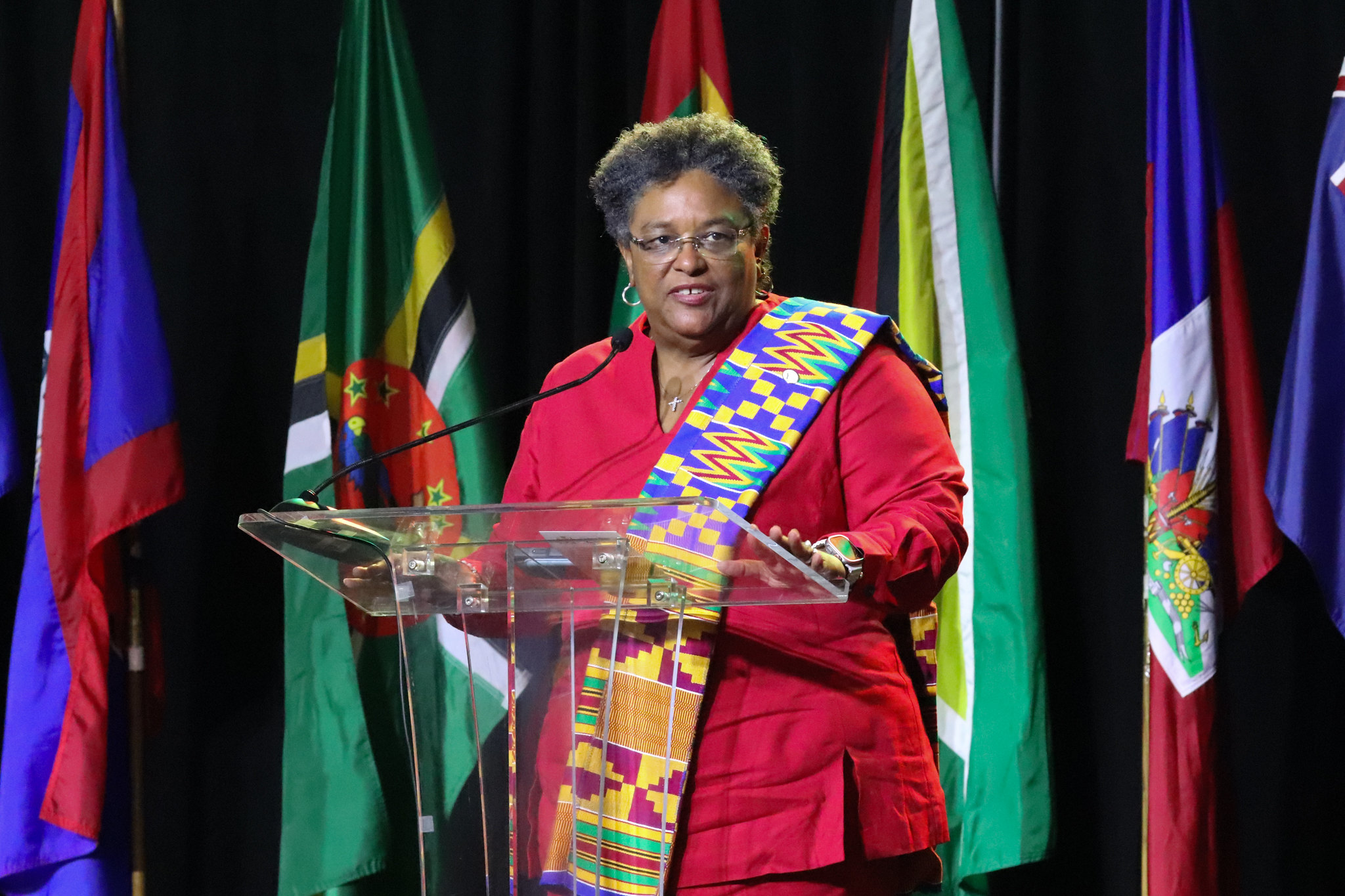



On January 18, 2026, Barbados Labour Party leader and Prime Minister Mia Amor Mottley announced that Barbadians will head to the polls on February 11, 2026, a full year before the constitutional deadline. This decision to call a snap general election has captured regional attention, not because Barbados is in political crisis, but because it reveals the interplay of domestic advantage, opposition weakness, and democratic norms in a small Caribbean republic that has arguably dominated its political landscape since 2018.
Mottley’s Barbados Labour Party (BLP) has held extraordinary dominance in Barbadian politics. After the party swept all 30 seats in both the 2018 and 2022 general elections, it has essentially governed without parliamentary opposition, with only a single opposition member emerging when former BLP MP Joseph Atherley left the party in 2018 to sit independently. This backdrop matters because a snap election in a Westminster-style system is most often about political timing: going to the electorate from a position of strength to pre-empt disadvantage or capitalize on continued popularity.
In Barbados’ case, the strategic logic for an early poll appears driven largely by domestic political advantage rather than external pressures. Regional pollster Peter Wickham has dismissed foreign influence explanations—such as reactions to global economic shifts or U.S. politics—as unfounded and instead emphasizes that Mottley had been contemplating an early election since late 2025, long before international events were discussed in public speculation.
The immediate political context at home highlights why such timing makes sense to the Prime Minister. The main opposition, the Democratic Labour Party (DLP), is deeply fractured. Its leader, Ralph Thorne, only assumed leadership in February 2024 after defecting from the BLP, inheriting a party that analysts describe as in “fundamental disrepair.” In this condition, the DLP has struggled to present a coherent platform, recruit candidates early, and rebuild voter confidence after years without legislative representation. Critics of the Democratic Labour Party had warned throughout 2025 that without renewal the party risked collapse—and that Mottley might exploit that weakness by calling polls early.
Mottley, 56, reframed the early dissolution as an appeal for democratic renewal, a fresh mandate for a government that has steered Barbados through its republic transition, pandemic recovery, and ongoing fiscal challenges. But more pragmatically, an early election avoids the risk that the opposition organisation improves significantly by 2027, giving the BLP a chance to consolidate its unrivalled position while rival parties are still coalescing.
Assessing her chances of returning to power, analysts are broadly skeptical that the BLP will lose its grip. Wickham notes that Mottley is generally favoured to win due to the lack of a credible challenger, though he warns that voter turnout, historically subdued, could be a defining factor if apathy deepens. Moreover, a fractured opposition risks splitting whatever anti-incumbent sentiment there may be among Barbadians.
There are risks and criticisms. Some democratic observers worry that repeated snap elections, particularly against a weakened opposition, could entrench one-party dominance and dilute effective accountability. But such concerns are balanced against Barbados’ stable institutions, strong civil society, and vibrant media environment that continue to operate outside direct partisan control.
In sum, Mia Mottley’s decision to call early polls is rooted in domestic political calculus—leveraging the BLP’s advantage amid an opposition in flux. Her prospects for a third consecutive term remain high, barring an unanticipated surge in turnout or a last-minute unifying opposition movement. In the February 11 contest, Barbados will once again reaffirm not just its leadership choice but also the underlying competitive health of its democratic system.
