





By Dr Jack Warner
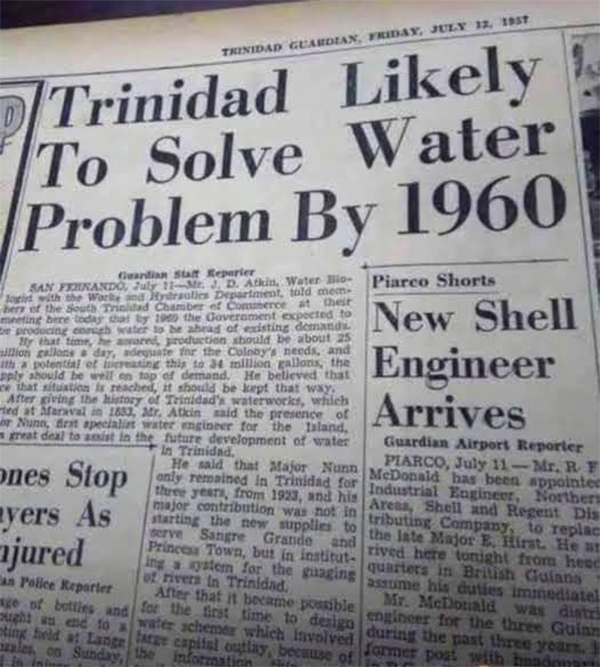
Since Basdeo Panday’s era and the governments before him, Trinidad and Tobago has heard the familiar promise of “Water for All”. Administrations have changed, ministers have come and minister have gone, and billions have been committed to water infrastructure. Yet, countless households still face dry taps, unpredictable schedules, and disturbing episodes of discoloured water. For too many citizens, obtaining something as fundamental as safe, reliable drinking water remains a daily struggle.
After decades of promises, the question is no longer whether the government recognises the problem. It is whether any administration is prepared to confront the institutional failures that have allowed it to persist.
The evidence is sobering. In May 2025, the Water and Sewerage Authority disclosed that only 27 per cent of its customers received continuous, 24-hour water service during the first four months of that year, compared with 19 per cent in 2024. These figures do not reflect a country that has repeatedly promised universal access to dependable potable water.

Behind these statistics are families storing water in drums, elderly citizens struggling to manage household necessities, parents worrying about sanitation and small businesses whose operations depend upon an unpredictable supply. Citizens pay not only through water rates and taxation but also through storage tanks, pumps, bottled water and the inconvenience of reorganising their lives around WASA’s schedules.
Recent complaints about discoloured water in several communities have intensified concerns about quality. WASA has attributed some incidents to temporary changes in distribution and pressure following maintenance disruptions, while maintaining that the affected water remained safe for domestic use.
But public confidence cannot rest on assurances alone. Consumers deserve timely, independently verifiable water-quality results, particularly when the water emerging from their taps appears dirty.
The problem is not simply insufficient rainfall or inadequate production. Ageing pipelines, leakage, inadequate maintenance, weak operational controls and uneven distribution have also contributed to unreliable service. Building additional treatment plants without repairing the networks carrying water to consumers risks pouring more resources into an inefficient system.
Fortunately, other countries have demonstrated that meaningful transformation is possible. Consider Cambodia’s capital, Phnom Penh. In 1993, its water utility struggled with deteriorated infrastructure, unreliable service, weak revenue collection, and water losses estimated at 72 per cent. Through sustained management reform, accurate customer records, metering, pipeline rehabilitation and stronger financial accountability, the utility reduced losses from 72 percent to approximately 8.75 per cent by 2023.
This was not achieved through slogans. It required disciplined leadership, measurable objectives and institutional reform.
Singapore offers another lesson. Its national water agency maintains a comprehensive programme of pipeline renewal, leak detection and preventive maintenance. In 2025, Singapore reported water losses of just 7.2 per cent. Advanced monitoring and rapid repairs help preserve supplies that would otherwise be wasted.
Trinidad and Tobago need not replicate either country’s system exactly. But we can adopt the principles that produced their results.

First, the government must establish a national water-reliability programme with clear, publicly monitored targets for continuous supply. Every community should have a documented service baseline, a realistic improvement timetable, and a way to verify whether promised schedules are honoured.
Second, reducing water losses must become a central operational priority. WASA should systematically identify leaking pipelines, replace deteriorated mains, improve pressure management and expand appropriate metering. Recovering water already produced may prove more economical than continuously expanding production.
Third, water quality must receive equal attention. Regular testing should be supported by publicly accessible results, independent oversight and immediate advisories whenever contamination is suspected. Discoloured water should trigger investigation and transparent communication, not political arguments over which administration experienced similar incidents.
Fourth, WASA requires stronger financial and managerial accountability. Infrastructure spending should translate into measurable improvements in reliability, reduced leakage, and service quality. Procurement, maintenance and operational performance should be subjected to rigorous independent scrutiny.
Fifth, the government must protect vulnerable households. Where reliable service remains unavailable, transparent emergency supply arrangements should prioritise schools, healthcare facilities, elderly residents and communities experiencing prolonged disruption.
Investment in desalination and new treatment capacity may be necessary, but every major project must demonstrate that the distribution network can deliver the additional water effectively.
Above all, water reform must survive changes of government. Trinidad and Tobago needs a funded, independently monitored, long-term national strategy that cannot be abandoned whenever a new minister assumes office. Citizens should not have to beg for water, protest outside WASA offices or purchase expensive storage equipment to compensate for institutional shortcomings.
Water for All must finally mean water that is safe, reliable and available when people need it. Other countries have transformed failing utilities through discipline, investment and accountability. Trinidad and Tobago can do likewise. What is required now is not another promise, but a government prepared to deliver measurable results and remain answerable until every community receives them.
