






…..Law Lord: “Complex legal Issues”
By FRANCIS JOSEPH
A very important matter came up for hearing before the Judicial Committee of the Privy Council on Wednesday.
After a full day of hearing, Lord Reed, President of the Court said, “I must say how grateful we are for all counsel’s assistance. We appreciate this is a case of great concern to many people on both sides of the debate in Trinidad and Tobago.
Any one who has watched this hearing will realize the case raises some really quite legal complex issues. It will take us time to consider those and we will let you have our decision when we can.”
Jason Jones, a LGBTQ activist, is challenging Sections 13 and 16 of the Sexual Offences Act, which among other things, prohibits buggery.
The Privy Council, comprising Lord Reed, Lord Sales, Lord Lloyd-Jones, Lord Briggs and Lady Rose, reserved judgment to a date to be fixed.
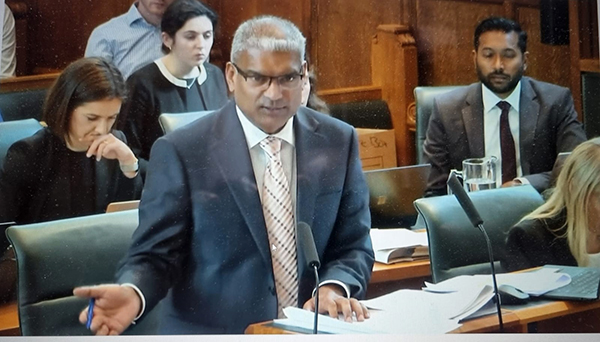
The respondents in the matter were the Attorney General, the Equal Opportunity Commission, and the Trinidad and Tobago Council of Evangelical Churches. Anand Ramlogan SC and Ganesh Saroop appeared for Jones, while Peter Knox KC and Robert Strang, appeared for the respondents.
THE ISSUE
Q: Do sections 13 and 16 of the Sexual Offences Act 1986 repeal and re-enact sections 59, 60 and 61 of the Offence Against the Person Act 1925 and so fall within section 6 of the Constitution of the Republic of Trinidad and Tobago?
Q: Do sections 13 and 16 of the Act infringe the fundamental rights guaranteed by section 4 of the Constitution?
Q: Are sections 13 and 16 of the Act reasonably justifiable, in whole or in part, in a society which has proper respect for the rights and freedoms of the individual?
FACTS
Jones, who was present in court, is a homosexual man. He sought a declaration that sections 13 and 16 of the Act infringe his fundamental rights under the Constitution. Section 13 of the Act prohibits “buggery”. Section 16 prohibits “sex acts” other than sexual intercourse.
Section 16 makes an exception to this prohibition for sex acts carried out in private between a male and a female who are both over the age of 16 and consent to the act.
Jones sought a declaration that sections 13 and 16 of the Act are unconstitutional. Jones argued that these sections infringe his right to respect for his private and family life, his right to liberty and security of the person, his right to equality before the law and the protection of the law, his right to freedom of thought and expression, and his right not to be subjected to cruel and unusual treatment or punishment.

On April 12, 2018, Justice Devindra Rampersad held that sections 13 and 16 of the Act were unconstitutional. The Court of Appeal, overturned the decision of the High Court. Jones then appealed to the Judicial Committee of the Privy Council.
Jones is a citizen of Trinidad and Tobago and is openly homosexual. His affidavit in support of his claim for constitutional relief stated that he is currently living in the United Kingdom. He periodically visits his home country where he has family and friends.
When in Trinidad and Tobago he suffers verbal abuse, harassment and prejudice on account of his sexual orientation.
As sexual relations between members of the same sex are criminalized in Trinidad and Tobago, Jones said he is unable to fully express his sexuality without being branded a criminal. He and others similarly situated must make a choice between breaking the law or forgoing a physically intimate relationship.
The criminalization of sexual acts between men legitimizes and reinforces the societal prejudice that he experiences, and has led even to family relationships becoming strained. Simply put, the provisions of the Sexual Offences Act mean that LGBT citizens do not have the same rights and freedoms as heterosexual individuals in Trinidad and Tobago.
Jones invited the British Judges to find that: –
(i) The Court of Appeal was wrong to decide that sections 13 and 16 of the SOA fall within section 6(2) of the Constitution.
(ii) The Court of Appeal was right to find that sections 13 and 16 have been shown not to be reasonably justifiable in a society with a proper respect for the rights and freedoms of the individual.
(iii) Section 13 of the SOA is invalid, void and of no force and effect.
(iv) Section 16 of the SOA is invalid, void and of no force and effect to the extent that the section criminalizes serious indecency between consenting individuals of the same sex acting in private.
(v) The Appellant’s appeal is allowed.
STATE RESPONSE
According to the State, there was no error of law in the Court of Appeal’s decision that the SOA 1986 was “an enactment which repeals and re-enacts with modifications” section 59 and section 61 of the Revised Offence Against the Person Act. Therefore, the court correctly held that sections 13 and 16 of the Sexual Offences Act were saved from challenge by Section 6(2) of the Constitution by
(a) increasing the maximum penalties for both offences and
(b) (in the case of s.16) extending the offence of serious indecency to consenting women.
The later statutory amendments, which simply increased the penalties under Sections 13 and 16, did not deprive them of this protection from challenge to this extent.
Therefore, for this further or alternative reason, both Sections 13 and 16 were valid laws, subject to their being read down to disapply the said further derogations and later amendments, and the Court of Appeal’s order should stand.
