





By Joey Bartlett
With her upcoming children’s book The Secret of the Arboretum set for release on May 23, Trinidadian author and environmental scientist Katrina Khan-Roberts is continuing a mission she believes is increasingly important: making science feel less intimidating and more alive for young readers.
“Making learning fun will ultimately benefit young people. Even the most non-scientific mind can grasp a concept if it is given in a fun and digestible way,” she says.
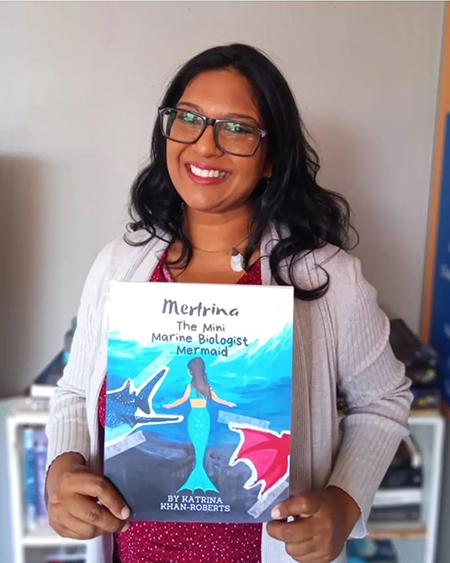
It was the same thinking for her 2025 children’s book Mertrina the Mini Marine Biologist Mermaid, a colourful blend of fantasy and environmental education that introduces marine science through the adventures of a curious young mermaid.
Published via Amazon in November 2025, the book was written for readers aged eight and up and centres on Mertrina, a young ocean explorer driven as much by curiosity as imagination. While the story leans into fantasy, its foundation is rooted in science, climate awareness and Caribbean identity.
For Khan-Roberts, the character is deeply personal. Growing up in San Fernando, she says her fascination with the ocean started almost as early as memory itself.
“Around the age of four, I was fascinated by the beach,” she recalls.
While many children were absorbed with toys or cartoons, Khan-Roberts found herself captivated by the shoreline, studying tide pools, marine creatures and the movement of the sea.
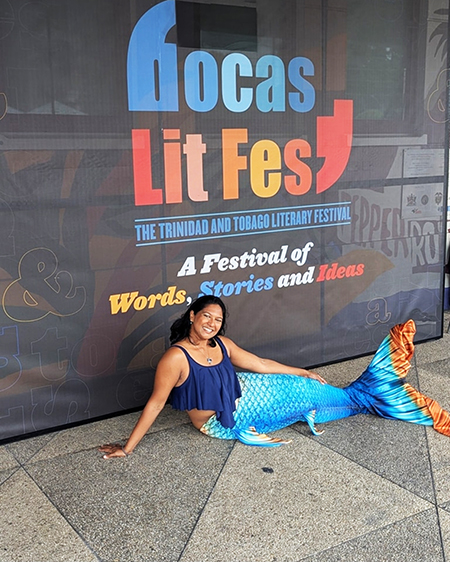
By age six, a cousin began calling her “Mertrina” because of her obsession with the ocean. That nickname eventually evolved into the title character of her book decades later.
Her childhood curiosity never faded. Instead, it deepened into academic study.
Khan-Roberts pursued a BSc in Environmental and Natural Resource Management with minors in marine biology and zoology, focusing on climate change and the vulnerability of coastal ecosystems in small island developing states.
She later completed a master’s degree in tourism development and management, expanding her understanding of how people, environment and sustainability intersect.
Despite years of academic writing and research, Khan-Roberts realised scientific information often struggled to reach everyday audiences, especially children. Before Mertrina, she had already written four science-focused books. This time, however, she wanted a softer and more imaginative approach.
“This book was the soft story,” she says. “The one that brought the concepts together gently.”
She said that approach became more important during the COVID-19 pandemic, as misinformation spread rapidly across digital platforms.
“It is imperative that information is accurate and fact-checked.”
Rather than presenting environmental issues in a heavy or technical way, Khan-Roberts wanted children to feel invited in. In Mertrina, lessons about marine ecosystems, conservation and biodiversity unfold naturally through storytelling and adventure.
The centre of all her books is the ocean itself, something Khan-Roberts believes Caribbean children should feel connected to, especially as climate change increasingly threatens coastal communities across the region.
“The ocean is vastly unexplored. Many of the processes on Earth depend on resources found there. We need to learn and protect it as island people.”
She believes storytelling can help bridge the gap between scientific theory and emotional connection.
“Biology gives the theory of how life functions,” she explains. “The more we understand, the better we are at being alive with our neighbours on this planet.”
That balance between imagination and education also shaped the book visually. Khan-Roberts spent two years developing the manuscript before dedicating another year to illustrating it by hand. Rejecting digital shortcuts, she painted every image using acrylic on canvas.
“It was challenging: timelines, planning, artwork, trying to complete the book in time,” she admits.
Now, with The Secret of the Arboretum preparing for release, Khan-Roberts is already expanding her world of environmentally driven storytelling. Alongside a developing young adult novel, she plans to continue exploring what she calls the “mermaid arc”, stories where science, curiosity and fantasy meet.
“We don’t know where Mertrina will visit next,” she says.
For aspiring writers, particularly those from scientific backgrounds , Khan-Roberts believes the biggest hurdle is often simply beginning.
“Begin to write,” she says. “It will unfold itself.”
