





By Dr Jack Austin Warner
For years, the people of Trinidad and Tobago were led to believe that fairness governed our society. If you failed to pay your electricity bill, your service would be disconnected—no questions asked and no exceptions granted. That was the rule for pensioners, small business owners, public servants, and labourers alike. It was not always pleasant, nor was it always popular, but it formed the bedrock of public trust. The belief that everyone, regardless of status or influence, was subject to the same standards was fundamental to our national identity.
Today, that belief has been severely shaken by revelations surrounding T&TEC’s so-called protected list.
The controversy has exposed troubling questions about governance, accountability, and equality before public institutions. More significantly, it has raised concerns about whether some individuals and entities received preferential treatment while ordinary citizens were subjected to strict enforcement measures.
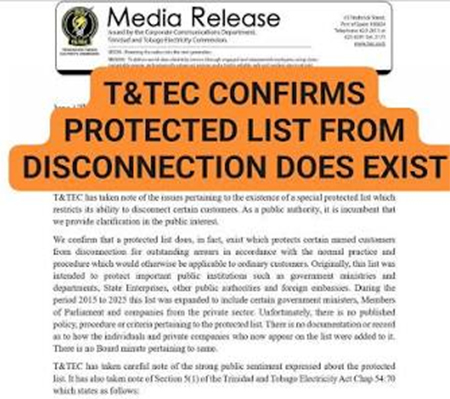
According to public disclosures, the protected list was originally intended to prevent the disconnection of critical national facilities. Most citizens would readily accept such a policy. No reasonable person would want hospitals, emergency services, embassies, or other essential institutions plunged into darkness because of administrative delays or accounting disputes.
The problem is that the list reportedly did not stop there.
T&TEC has acknowledged that, over time, the protected list expanded to include politicians, Members of Parliament, and private companies. Equally troubling are reports that there was no clearly documented policy, established criteria, or formal board approval governing its operation. If those reports are accurate, they raise serious concerns about transparency, oversight, and the exercise of discretionary power.
That revelation should concern every citizen, regardless of political affiliation.
This is not merely a question of who appeared on the list. It is a broader question about whether public institutions were administered fairly and consistently. While ordinary citizens faced the prospect of disconnection for arrears, some individuals and entities reportedly enjoyed protection from similar consequences. Such a perception creates the appearance of a two-tiered system—one for the powerful and another for everyone else.
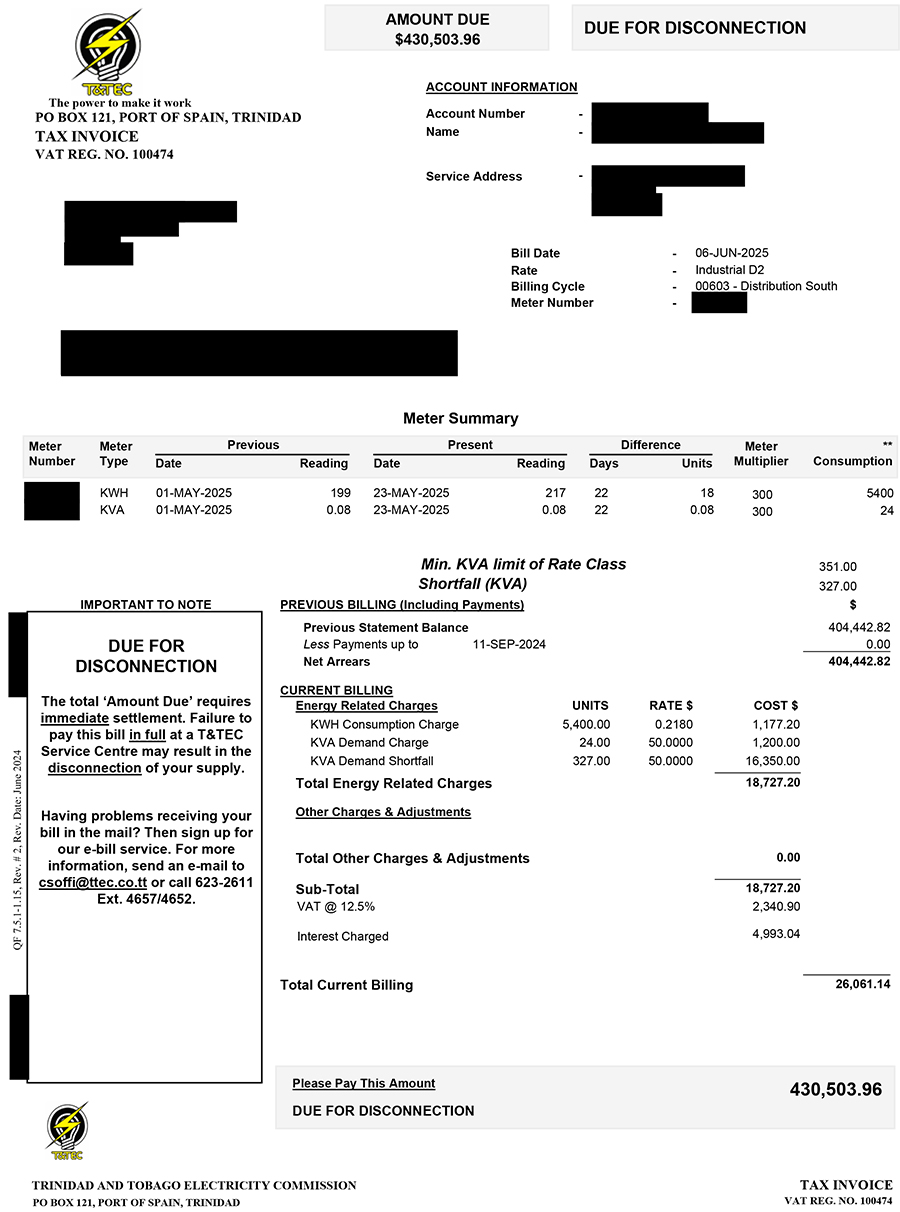
The issue becomes even more uncomfortable when specific examples emerge. Publicly circulated information identifies a southern company reportedly linked to a close associate of the former Prime Minister as having an account owing $430,503.96 and marked for disconnection. The reported arrears accumulated between June 1, 2015, and May 1, 2025, and allegedly remained unpaid as of May 23, 2025.
Naturally, several questions arise.
Was the company disconnected?
If not, why not?
Did its inclusion on the protected list influence the treatment it received?
Were similar concessions extended to others?
Most importantly, what happens now?
That final question is where political rhetoric ends and the real test begins.
The Government has appropriately expressed concern about the existence of the protected list. Public outrage has followed. Accusations have been exchanged, and explanations have been offered. Yet none of these developments answers the question now being asked by citizens across the country.
Will the Government require those who benefited from the protected list to settle any outstanding arrears?
If substantial sums remain unpaid, will collection efforts proceed?
If payment is not made, will disconnections occur?
Or will the country simply be told that the practice was wrong while those who benefited from it continue to receive treatment unavailable to ordinary customers?
If equality before public institutions is the principle being defended, then it must be applied consistently. It cannot apply only to the struggling family in Morvant, the retiree in Siparia, or the small business owner in Les Coteaux. It must also apply to politicians, politically connected individuals, and private companies.
Anything less would risk reducing this entire exercise to little more than political theatre—an attempt to appease public anger without addressing the underlying problem.
The deeper issue extends far beyond electricity bills. Public institutions derive their legitimacy from public confidence. Citizens comply with regulations, pay taxes, and accept enforcement measures because they believe the rules are being applied fairly and impartially.
The moment people begin to suspect that influence, status, or political connections determine how public institutions operate, trust begins to erode.
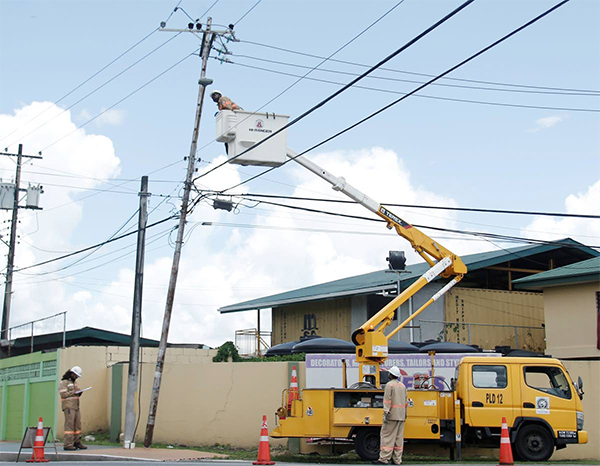
That is why this matter cannot end with vague explanations, incomplete disclosures, or assurances unsupported by meaningful action. The country deserves transparency, accountability, and a full accounting of how the protected list was created, expanded, and administered.
The public has a right to know who benefited, who authorised the arrangements, and what corrective measures will now be taken. Anything less risks further undermining confidence in public institutions.
Above all, citizens deserve an answer to a very simple question.
If an ordinary citizen fails to pay an electricity bill, service will eventually be disconnected.
If a protected customer fails to pay, will the same rule apply?
That is the real test.
Because the issue before the nation is no longer simply the existence of a protected list. The larger question is whether Trinidad and Tobago is prepared to reaffirm the principle that no individual, company, or political figure stands above the rules that govern everyone else.
A society cannot long endure when privilege replaces fairness and influence replaces accountability.
