





A Quiet Referendum on Trinidad and Tobago
By Dr Jack Austin Warner
I must confess that I never expected the phenomenal response to my recent reflections published in the Sunday newspapers on May 31, titled Life is a Stage and We Are All Characters, inspired by Brother Valentino’s timeless calypso. One writes these pieces with the hope that they will provoke thought and perhaps stimulate a conversation. What I did not anticipate was the extent to which that conversation would spread across so many different corners of Trinidad and Tobago and beyond.
The responses came from politicians, both past and present, representing different sides of our political divide. They came from academics, members of the medical fraternity, business leaders, church leaders, public servants and citizens living abroad. They came from old friends and longstanding critics. Most importantly, they came from ordinary men and women whose names may never appear in newspaper headlines, but whose daily experiences shape the reality of this country far more than any speech delivered from a political platform.
One comment stayed with me. A gentleman wrote on social media: “I was never a fan of Jack Warner, but I am a strong fan of this article.” I smiled when I read it. Not because it was praise, but because it revealed something important. For a brief moment, personalities, political loyalties and historical disagreements were pushed aside. What remained was a shared recognition that something about Trinidad and Tobago today feels unsettled, as though the script we have been following for years is no longer producing the outcomes that citizens desire.
At my age and stage of life, one becomes increasingly aware that public office, professional accomplishments and political victories are all temporary. What endures is one’s contribution to the society. Throughout my life, whether people agreed with me or not, I have always believed that service to Trinidad and Tobago should remain the ultimate objective. The article was not written to score political points or settle old scores. It was an honest reflection born out of a desire to see our national story take a different direction, one that offers greater hope, greater trust and greater opportunity for future generations.
The overwhelming reaction suggests that many citizens share that desire. People may disagree on the causes of our challenges, and they may certainly disagree on the solutions, but there appears to be broad agreement that many aspects of national life are not functioning as they should.
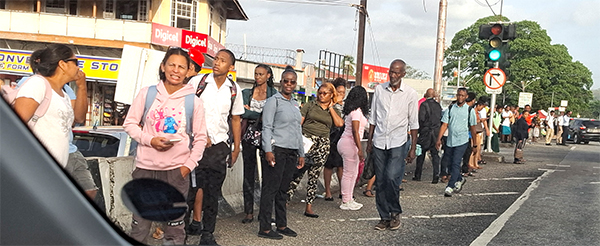
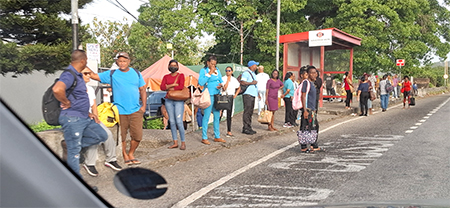
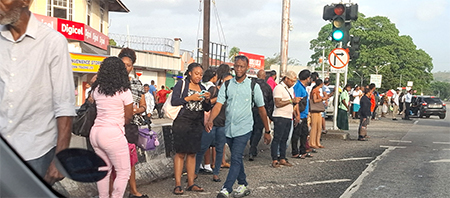
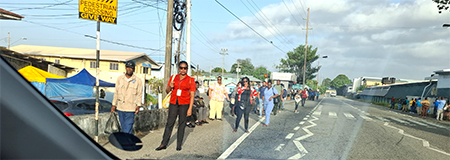
That thought returned to me on Monday morning as I made my usual early morning journey to my office. Along the roadway I saw scores of people gathered at bus stops and transportation hubs. There were schoolchildren in neatly pressed uniforms, workers preparing for another day on the job, elderly citizens waiting patiently, and parents trying to coordinate the logistics of getting their families where they needed to go.
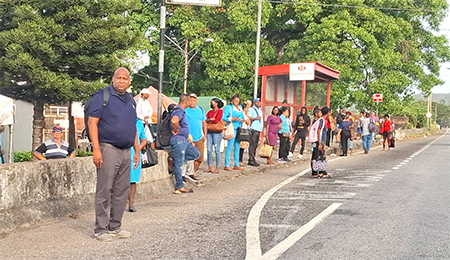
Seeing the unusually large crowds of persons I was immediately reminded of the threatened protest action by red band maxi taxi operators. Let me say at the outset that I do not pretend to know what the protest is about, nor am I seeking to determine who is right or wrong. What struck me was not the absence of the maxis. It was the presence of the people.
The maxi operators were making a statement, but they were doing so without placards, without loudspeakers, without roadblocks and without violating any of the guidelines recently outlined by the Trinidad and Tobago Police Service regarding public demonstrations. Yet their message could not have been louder. By simply withdrawing a service upon which thousands depend, they demonstrated the extent to which transportation remains an essential component of daily life and economic activity.
What I witnessed was, in its own way, a form of protest. Peaceful. Orderly. Highly visible. More importantly, it reminded us that behind every public policy discussion lies a human reality. Perhaps that is one of the reasons why so many people connected with my original article.
I reiterate, the piece was never really about politics. It was about the growing feeling among many citizens that too often we have become trapped in repetitive acts of the same national production. The characters change, the costumes change and sometimes even the stage changes, but the underlying storyline remains remarkably familiar.
Nations are not built because everyone agrees. In fact, healthy societies depend upon vigorous debate and competing ideas. What successful nations possess, however, is a shared commitment to certain fundamental principles: accountability, competence, fairness, trust and a belief that the future can be better than the present or the past. Without those shared principles, politics becomes little more than an endless contest for power. With them, politics becomes a vehicle for national development.
A common thread in the reactions to my article was the consistency of the message – people are assessing the state of the nation. They are weighing what is working against and what is not. They are measuring promises against outcomes. In many ways, Trinidad and Tobago appears to be engaged in what can only be described as a quiet referendum on national performance.
The maxi taxi disruption is one example. Whether one agrees with the operators or not, their action became a visible reminder that groups across society are seeking ways to communicate concerns that they believe are not being adequately heard. The effectiveness of the protest lay not in confrontation but in its ability to reveal how interconnected our society has become. Thousands of people were affected not because anyone blocked a road or waved a placard, but because a service upon which they depend simply was not there.
For too long we have allowed ourselves to believe that every issue must be viewed through a political lens. Yet the parent waiting for transportation to get a child to school is not experiencing a political problem. The young graduate struggling to find opportunities is not experiencing a political problem. The business owner trying to navigate economic uncertainty is not experiencing a political problem. They are experiencing national challenges that demand national solutions.
Brother Valentino’s calypso endures because it captures a universal truth. Life is indeed a stage and we are all characters. The politician has a role to play. So does the public servant, the teacher, the police officer, the businessman, the trade unionist and the citizen. The success of the production depends not only on the lead actors but on the entire cast. The good news is that scripts can be rewritten.
History is filled with examples of countries that confronted periods of uncertainty and emerged stronger because they were willing to acknowledge uncomfortable truths and embrace meaningful change. Trinidad and Tobago is no different. We possess extraordinary talent, abundant creativity, resilient people and resources that many nations can only dream about. What we require now is the collective will to write a better chapter. And perhaps that is what Brother Valentino was reminding us all along.
The stage is still here. The actors are still here. The audience is still here. But as the curtain rises on the next act, one question hangs in the air above the national theatre: Will we continue to perform the same familiar script, or will we finally summon the courage to write a better one?
The answer, as always, lies not with one actor, one party, one institution or one leader. It lies with all of us.
