





Football supporters have always understood that referees make mistakes. A mistimed whistle, an incorrect offside call or an inconsistent disciplinary decision may provoke anger, but it does not ordinarily destroy faith in the competition. The game survives human error because supporters generally believe the error was honest. What football cannot easily survive is the suspicion that decisions are now being shaped by political access, personal relationships or pressure from powerful governments. That is the dangerous territory into which FIFA has now wandered.
The important question is no longer simply whether Gianni Infantino has become too close to United States President Donald Trump; it is whether that closeness has damaged public confidence so severely that supporters can still accept World Cup outcomes as products of what happened on the field. That does not mean there is proof that matches are being fixed, but institutional legitimacy does not collapse only when corruption is conclusively demonstrated. It also collapses when decision-making becomes so opaque, inconsistent and politically contaminated that reasonable people begin to doubt the process.
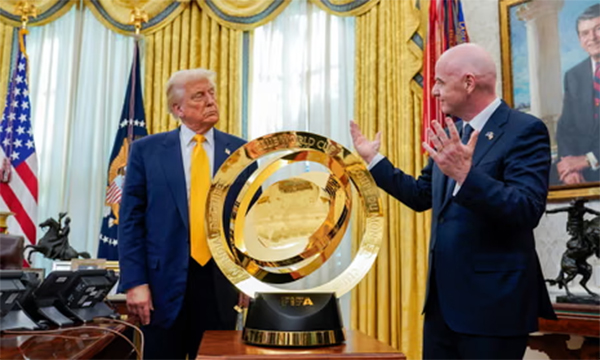
FIFA created an inaugural Peace Prize and presented it to President Trump during the December 2025 World Cup draw in Washington. FIFA officially described the honour as recognition for actions that helped unite people in peace, but the award inevitably deepened perceptions of an unusually intimate relationship between the FIFA president and the leader of the principal host nation.
That relationship became more consequential when Trump publicly intervened in the disciplinary consequences flowing from the red card shown to United States forward Folarin Balogun. FIFA initially defended the referee’s professionalism and the legitimacy of the on-field decision. Yet Balogun’s automatic suspension was subsequently lifted after Trump had asked Infantino to review the matter, allowing the player to appear in the United States’ next match. That is where the issue moved beyond embarrassing political theatre.
A referee’s decision is supposed to pass into an established disciplinary structure governed by published laws and independent adjudication. According to reporting by the Financial Times, the committee that suspended Balogun’s ban has been criticised for secrecy, unclear authority and a practice in which disciplinary decisions are frequently issued by a single official rather than the full committee. Legal experts quoted in that reporting questioned whether FIFA’s rules permitted the automatic sanction to be displaced in the manner used. FIFA has not publicly released a full explanation capable of resolving those concerns.
The problem is not merely that a politician complained. Politicians complain about sport constantly. The problem is that the complaint appears to have been followed by a favourable institutional outcome, while FIFA provided insufficient transparency to prove that the two events were unrelated.
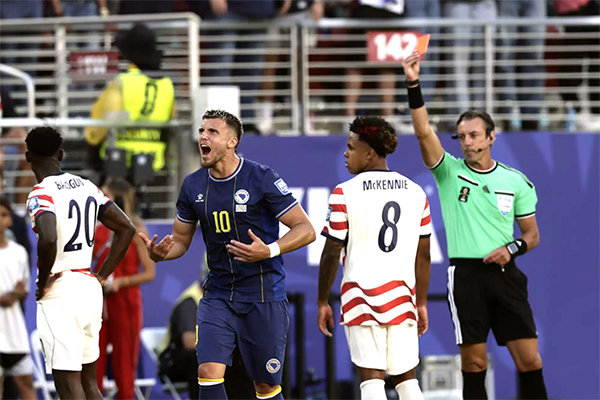
forward Ermedin Demirovic reacts and U.S. midfielder Weston McKennie looks on
That creates a corrosive precedent. If the president of a host country can telephone the president of FIFA about a disciplinary decision involving his national team, what should supporters conclude when the decision changes? If the change was entirely lawful, why was the reasoning not immediately published in full? Why should football followers be required to accept assurances from the same institution whose leadership cultivated the political relationship now under scrutiny?
Football does not require blind trust
FIFA’s statutes emphasise political neutrality and require football bodies to remain independent of external political interference. FIFA has invoked these principles repeatedly against national associations where governments attempted to influence football administration. Yet neutrality cannot be a disciplinary weapon used against weaker countries while becoming elastic in the presence of a powerful host government.
This does not prove that the World Cup itself is scripted. It does not establish that referees have been instructed to favour particular teams, nor does it demonstrate that FIFA has manipulated match results. Indeed, FIFA’s public support for the referee who dismissed Balogun runs counter to the most extreme version of that accusation, but institutional trust is not protected by demanding that critics produce evidence of a conspiracy before they may ask questions. Trust is protected through consistent rules, visible independence, and transparent reasoning.
The concern becomes sharper when placed against the wider refereeing controversies surrounding the tournament. Reuters has reported sustained criticism of FIFA’s expanded use of VAR and connected-ball technology, with players, coaches and supporters objecting to inconsistent intervention, opaque thresholds and technically precise decisions that appear detached from the spirit of the game. Technology was supposed to remove suspicion. Instead, when administered through an institution already facing questions about political influence, it can magnify it.
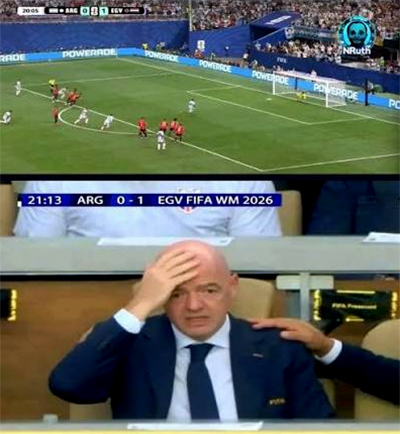
from the penalty spot in the 20th minute. But the unthinkable happened,
the Argentine superstar missed. It was the reaction of FIFA president Gianni
Infantino. The shock, the emotion, and the disappointment on his face
immediately sparked debates across social media.
A decision measured to the millimetre is not necessarily trusted if the institution applying the measurement is viewed as selective.
This is FIFA’s self-inflicted crisis. The governing body may insist that every result remains legitimate, every referee independent and every disciplinary outcome legally justified. Those claims may all be true but after embracing political pageantry, rewarding a powerful host president and failing to explain adequately why an intervention concerning his national team was followed by a reversed sanction, FIFA can no longer expect the football world to accept its word without scrutiny.
The real danger is, therefore, not proven match manipulation. It is the collapse of the presumption that manipulation is unthinkable.
Once supporters begin watching a penalty, red card or VAR reversal and asking not whether the official made a mistake but who may have spoken to whom, football has already lost something fundamental. The World Cup depends upon the belief that history is being made by players on grass, not negotiated by powerful men away from public view.
FIFA must now publish the full legal basis for the Balogun decision, disclose who participated in it, establish whether political contact occurred before the ruling and strengthen the formal separation between its president and its disciplinary machinery. Anything less leaves the tournament under a shadow of FIFA’s own making, even the eventual winner of the World Cup.
Football does not require blind trust. It requires earned trust. Gianni Infantino has placed that trust at risk, and unless FIFA restores transparency and institutional distance, every outcome, controversial or not, will carry a question the sport should never have allowed to take root: are we watching competition or influence disguised as competition?
Jack Austin Warner PhD
Former FIFA Vice President
