





Fix the Illegal Parking Problem
BY JACK AUSTIN WARNER PhD
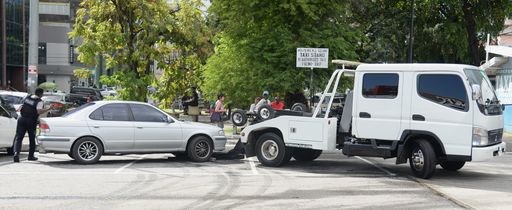
If I were the Prime Minister of Trinidad and Tobago, I would make one decisive change to how we deal with parking offences: I would end the routine issuance of parking tickets and replace it with a clear, consistent policy of towing vehicles that are badly and illegally parked.
Not selectively, not sporadically, and not only in high-profile areas, but as a national standard, applied evenly and predictably.
The current system does not work. Parking tickets have become an administrative ritual rather than an effective deterrent.
Drivers who park illegally receive tickets that may or may not be paid, challenge them in court, or ignore them entirely, and the cycle continues.
Roads remain blocked, traffic worsens, police time is wasted, and public frustration grows. Towing, by contrast, is immediate, visible, and consequential, and that is precisely why it works.
The first major advantage of a towing-first approach is the potential for judicial relief. Our courts are clogged with minor traffic matters, including disputes over parking tickets. Many of these cases hinge on technicalities, unclear signage, or disputes over enforcement.
When a vehicle is towed, the issue is no longer a drawn-out contest over a piece of paper. The offence is resolved administratively. Vehicles are retrieved upon payment of a clearly defined fee, and only serious disputes proceed further. This alone would significantly reduce the burden on magistrates and court staff.
Second, towing removes ambiguity in enforcement and payment. With parking tickets, errors are common: missed deadlines, unpaid fines, inconsistent penalties, and backlogs in processing.
Towing creates a single, transparent process. If your vehicle is illegally parked, it will be removed. If you want it back, you pay the prescribed fee.
There is no confusion, no delayed enforcement, and no accumulation of unpaid penalties that eventually become unenforceable.
Third, towing changes behaviour. Tickets have become a calculated risk. Many drivers knowingly park illegally, assuming that the worst outcome is a fine they may never pay.
Towing eliminates that calculation. The inconvenience of retrieving a vehicle, the time lost, and the immediate financial cost create a strong deterrent.
When drivers know their vehicle will be removed, not ticketed, they would think twice. Over time, illegal parking declines, not because of fear, but because expectations are reset.
Fourth, the benefits to traffic flow are immediate and measurable. Illegally parked vehicles choke major arteries, narrow already tight roadways, obstruct pavements and pedestrian crossings, and slow emergency response.
Towing clears lanes in real time. It allows smoother transitions along the nation’s roads, reduces congestion hotspots, and improves safety for drivers, pedestrians, and cyclists alike.
In urban centres, especially, the difference between ticketing and towing is the difference between stagnation and movement.
Fifth, towing improves officer safety and efficiency. Writing tickets places police officers in vulnerable positions; standing in traffic, engaging with hostile drivers, or returning to vehicles where tempers have flared.
When towing is the standard, the enforcement action is swift and procedural. Officers supervise removal rather than debate offences. This reduces confrontation, shortens interaction time, and lowers the risk of escalation with “John Public.”
Beyond these immediate advantages, towing creates secondary benefits that a ticket-based system cannot. Vehicles that are towed can be systematically checked for other traffic-related issues: expired insurance, unpaid licences, unsafe modifications, or outstanding warrants.
Offences can then be addressed appropriately, either through charges or warnings. This improves overall compliance across the traffic ecosystem, not just parking.
There are also economic benefits. A structured towing system generates reliable revenue that can be reinvested into road maintenance, traffic management infrastructure, and public transport improvements.
Unlike ticket revenue, which is often delayed, contested, or uncollected, towing fees are immediate and predictable.
Additionally, regulated towing services create employment: drivers, mechanics, administrative staff, and storage facility workers.
With proper oversight, this can become a professional, accountable sector rather than a fragmented or ad hoc operation.
Critically, towing promotes fairness. A well-designed system does not discriminate between vehicles, drivers, or neighbourhoods.
The rules are clear, signage is unambiguous, and enforcement is consistent. This reduces accusations of selective policing and restores public confidence in traffic management.
When everyone knows the consequence and sees it applied uniformly, compliance becomes the norm.
Of course, towing must be implemented responsibly. Clear signage, public education, reasonable grace periods in non-critical areas, and transparent fee structures are essential.
There must be accessible appeal mechanisms for genuine errors. But these safeguards strengthen the system; they do not weaken the case for towing.
Ultimately, parking enforcement is not about punishment. It is about order, safety, and respect for shared space.
Roads are public assets, not personal storage areas. When vehicles are allowed to obstruct our roads with minimal consequence, everyone pays in time, frustration, and risk.
If I were the Prime Minister, I would choose the policy that works. Towing does not merely penalize bad parking; it prevents it.
It clears roads, eases the courts, protects officers, changes behaviour, creates jobs, and restores discipline to our transport system. In a country struggling with congestion, enforcement fatigue, and institutional overload, this is not a radical idea. It is a practical one.
