


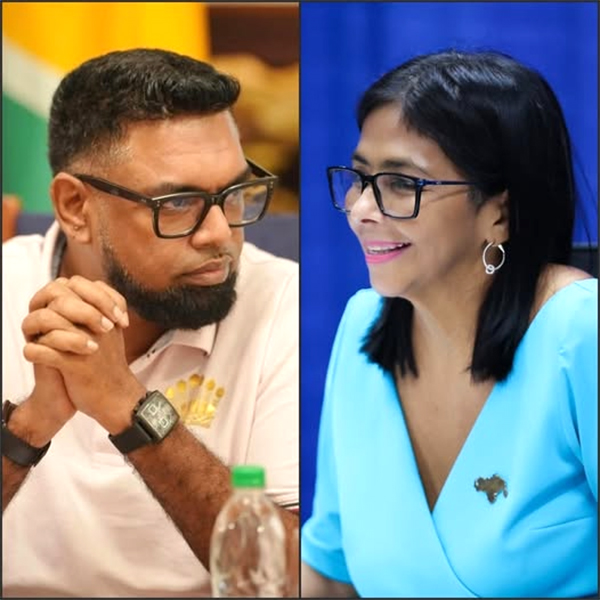



STATEMENT BY THE PRESIDENT OF GUYANA
Office of the President
Shiv Chanderpaul Drive & South Road,
Bourda, Georgetown,
Co-operative Republic of Guyana
28th April 2026
Hon. Prime Minister, Dr. Terrance Michael Drew
Prime Minister and Minister of Finance, National Security, Citizenship and Immigration, Health and Human Resource Management and Social Security
Chairman of Caricom
St. Kitts and Nevis
Dear Brother Terrance,
I note with grave concern the public display by Venezuela’s Acting President Delcy Rodriguez, during official engagements in Member States of the Caribbean Community, of a map purporting to incorporate Guyana’s Essequibo region as part of Venezuela.
Guyana fully respects the sovereign right of CARICOM Member States to conduct bilateral relations with all partners, including the Bolivarian Republic of Venezuela. However, it is deeply regrettable that such engagements have been accompanied by the prominent display of symbols asserting Venezuela’s claim to Guyana’s territory.
The use of CARICOM engagements to project or promote a territorial claim against a Member State risks being interpreted as acquiescence or tolerance. No action, whether deliberate or inadvertent, should create the impression that the Community’s platforms may be used to advance claims now before the International Court of Justice. CARICOM’s principled support for Guyana must be reflected not only in declarations, but also in the context and conduct of official engagements.
This is not a matter of symbolism alone. It is a calculated and provocative assertion of a claim that Guyana has consistently and lawfully rejected, and which is before the International Court of Justice for final adjudication.
Venezuela cannot, while the case is before the Court, seek to normalise by symbols, maps, legislation, appointments or official display what it has failed to establish in law. Such conduct does not strengthen Venezuela’s case; it undermines confidence in its stated commitment to peaceful settlement, international law, and good neighbourly relations.
Guyana recalls its consistent position that the boundary was settled by the 1899 Arbitral Award, which determined the boundary as a full, perfect and final settlement. Venezuela’s revival of the claim decades later, and its more recent measures purporting to annex the Essequibo and appoint officials for that territory form part of a pattern of conduct inconsistent with international law and the process to which the matter has been submitted.
These actions persist notwithstanding the Order of the Court of 1 December 2023, which required Venezuela not to take any action that would modify the situation that currently prevails in the territory in dispute, whereby Guyana administers and exercises control over that area, and required both Parties to refrain from any action that might aggravate or extend the dispute or make it more difficult to resolve.
I am writing to you, the current Chairman of CARICOM, conveying Guyana’s concern and urging continued vigilance in safeguarding the Community’s principled position.
Guyana reminds all CARICOM Heads of Government of their repeated and unequivocal support for Guyana’s sovereignty and territorial integrity, and for the resolution of the controversy through the judicial process before the Court. That position was reaffirmed most recently at the Fiftieth Regular Meeting of the Conference of Heads of Government.
Guyana remains fully committed to the peaceful resolution of this matter in accordance with international law. We continue to repose our confidence in the Court and to respect its processes and eventual judgment.
At the same time, Guyana expects all States, including Venezuela, to act consistently with the principles of the United Nations Charter, refrain from provocation, and respect the ongoing judicial process.
With the highest regards,
Dr. Mohamed Irfaan Ali
President of the Co-operative Republic of Guyana
_____________________________________
STATEMENT BY CARICOM:
*STATEMENT from the Caribbean Community | 28 April 2026*
The Caribbean Community (CARICOM) has taken note of recent official engagements within the Community during which material asserting Venezuela’s claim to Guyana’s Essequibo region was on public display. CARICOM also notes the letter of 28 April 2026 from President Mohamed Irfaan Ali expressing Guyana’s grave concern.
CARICOM reaffirms that each Member State retains the sovereign right to conduct bilateral relations with external partners. This principle is well established and respected within the Community. Those engagements are conducted in a manner consistent with the shared obligations and collective commitments of CARICOM.
At the centre of those commitments stands the Revised Treaty of Chaguaramas, the binding legal instrument that defines the Community, its objectives, and the conduct expected of its Member States. The Treaty commits Members to the preservation of the Community’s integrity and cohesion in their external relations.
In the exercise of their sovereign rights, Member States remain mindful of their collective responsibilities to the Treaty and to uphold the principles of international law, respect for judicial processes and good neighbourly relations.
In this regard, CARICOM underscores that Community platforms and engagements should not be used, whether directly or indirectly, to advance or appear to legitimise claims that are the subject of ongoing judicial proceedings before the International Court of Justice.
The Community’s longstanding and unequivocal support for the sovereignty and territorial integrity of Guyana, and for the peaceful resolution of the controversy through the Court remains firm and unchanged.
CARICOM remains committed to unity, to the rule of law, and to the peaceful settlement of disputes in accordance with international law.
28 April 2026
