




By: Joey Bartlett
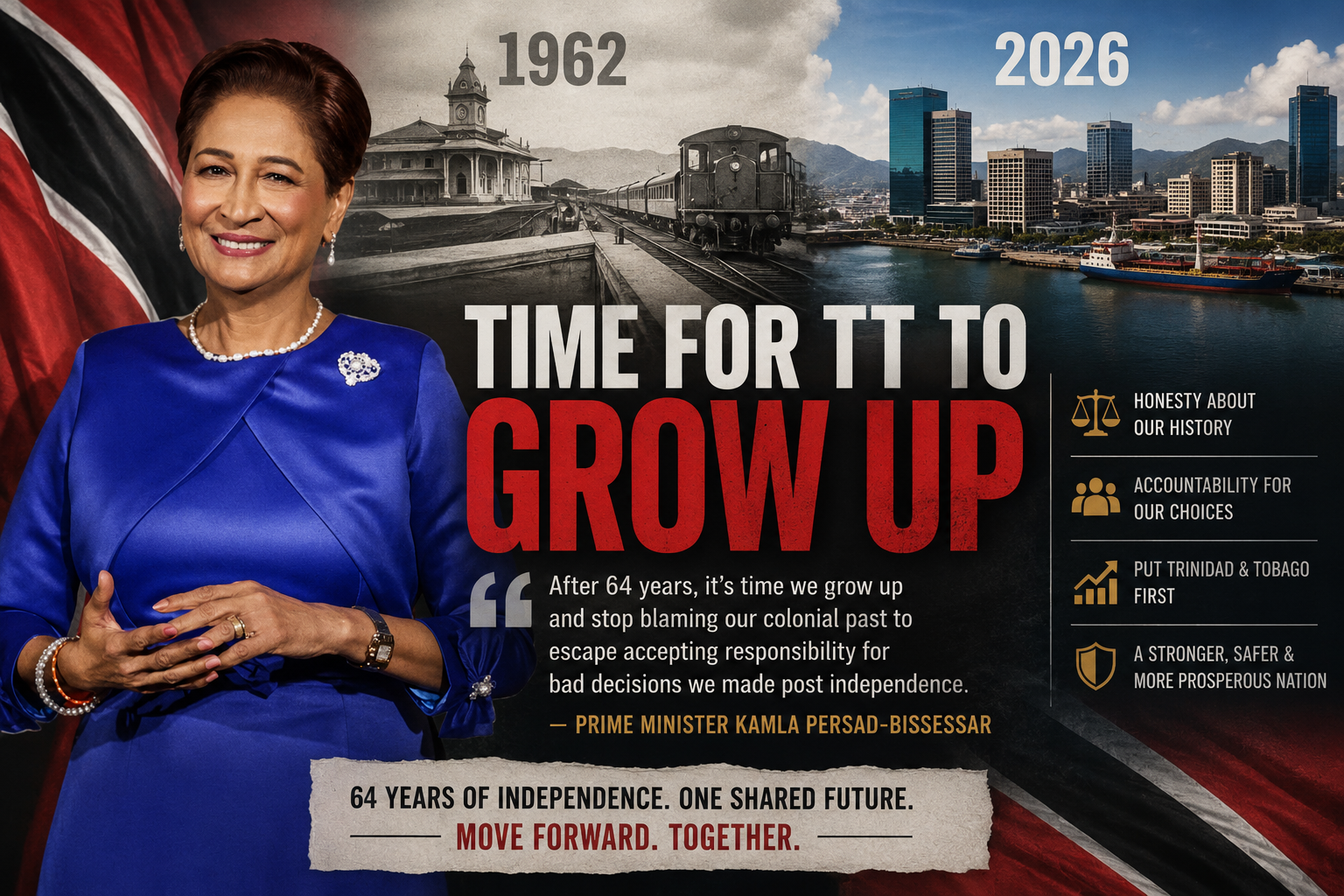
Prime Minister Kamla Persad-Bissessar is calling on Trinidad and Tobago to stop looking backwards and take responsibility for where the country stands 64 years after independence.
In an Independence Day message posted on August 30, on the United National Congress’ Facebook page and later reshared on Persad-Bissessar’s page. She argued the country has fallen short of the promise it showed when it became independent in 1962.
“We must confront our post-independence history with honesty.” Persad-Bissessar said, adding that Trinidad and Tobago “should have done much better” over the past 64 years given what she described as the “strong foundation left by the British”.
She highlighted the country’s economic standing at independence as evidence.
Persad-Bissessar said Trinidad and Tobago then had a higher per capita income than countries including Japan, Chile, Greece, Spain, Hong Kong, Singapore, Portugal, Mexico, Turkey, Iraq, Brazil, Malaysia, Iran, Morocco, Taiwan and China.
“All of these countries have now superseded us,” she said.
She also highlighted what she described as a well-organised legal and governance system, an advanced oil exploration and refining industry, a strong agricultural sector, a developed railway network, low crime and a clean environment.
“The fact is that the British left us a very prosperous, functioning country in 1962,” she said.
But Persad-Bissessar said the country now needs to take a harder look at the choices made since independence rather than continually blaming its problems on colonialism.
“After 64 years, it’s time we grow up and stop blaming our problems on our colonial past to escape accepting responsibility for bad decisions we made post independence that have resulted in negative consequences for ourselves and our nation,” she said.
She acknowledged people make mistakes but warned against repeatedly choosing shortcuts in the pursuit of quick success.
“We all fall at times,” she said. “We all repeatedly, knowingly, make regrettable choices, and we all foolishly take shortcuts that are not in our best interest to chase quick success.”
Persad-Bissessar then turned her attention to what she described as a shared responsibility to put the country ahead of individual differences.
“Whatever our shortcomings, biases and grievances, we share one citizenship, one homeland and a collective duty to put Trinidad and Tobago first,” she said.
For Persad-Bissessar, that means moving beyond blame and accepting accountability for the country’s future.
“We have to move forward with conviction and accountability,” she said, “to be able to bequeath to future generations a stronger, safer and more prosperous nation.”
