


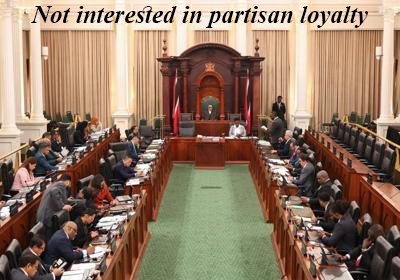



Regardless of where a candidate stands on the political spectrum, and irrespective of the party to which they belong, I believe there are certain standards of leadership that should precede ideology.
I am less interested in political theater than in political character; less interested in partisan loyalty than in intellectual honesty; and less impressed by the volume of a candidate’s rhetoric than by the quality of their judgment.
At the foundation is character. I do not expect political leaders to be flawless—I expect them to be accountable. I look for people whose convictions do not change with the audience, whose principles are not auctioned for applause, and who possess the humility to acknowledge error without treating admission as defeat. Power is revealing. The question is not merely what a person intends to do with it, but what restraints they impose upon themselves once they possess it.
I look for competence joined to judgment. Governing is not a debating contest, nor is it an exercise in perpetual campaigning. It is the difficult art of translating principles into decisions, priorities, laws, institutions, and consequences. I want leaders who understand that every promise carries a cost, every policy creates trade-offs, and every decision has consequences that may extend far beyond the news cycle. Serious leadership requires the courage to tell citizens not only what they want to hear, but what they need to understand.
I value intellectual independence. I have little admiration for politicians whose certainty is determined by their party affiliation. A serious leader should be capable of encountering an inconvenient fact without immediately searching for a partisan explanation, and of recognizing merit in an opposing argument without experiencing that recognition as betrayal. Changing one’s mind in the presence of better evidence is not weakness. It is one of the clearest signs that reason is still functioning.
I look for conviction tempered by humility. A leader without convictions is merely a weather vane; a leader without humility can become a danger to the very institutions they were elected to serve. The ideal lies somewhere between the two: the willingness to stand firmly when principle requires it, coupled with the wisdom to recognize that one’s own understanding is necessarily incomplete.
I also look for courage of a particular kind: the courage to resist one’s own political constituency when conscience, evidence, or the public interest requires it. It is easy to be brave in front of people who already agree with you. The more consequential test is whether a politician can disappoint their own supporters for the sake of something larger than their political survival.
I expect respect for constitutional government and democratic institutions. Elections are not merely mechanisms for installing our preferred people in office; they are part of a larger system designed to constrain power, protect rights, permit peaceful disagreement, and make political authority temporary. A candidate who respects democracy only when victorious has misunderstood democracy altogether.
I want leaders who understand that opposition is not treason and disagreement is not hatred. A republic cannot survive if every political contest is framed as an existential struggle between patriots and enemies. Political opponents may be mistaken, misguided, or deeply wrong on matters of consequence—and still be fellow citizens entitled to dignity and participation in the civic life of the nation. The objective of politics should ultimately be persuasion and governance, not permanent mobilization against an enemy.
I look for stewardship rather than self-importance. Public office is not a coronation. It is a temporary custody of power on behalf of people who will remain after the officeholder is gone. The strongest leaders understand that their legacy is not measured solely by how often their name appears in headlines, but by whether the institutions they leave behind are stronger, the public discourse more honorable, and the country more capable of governing itself.
And I look for proportion—perhaps the rarest quality in modern politics. Not every disagreement is a catastrophe. Not every election is the last stand of civilization. Not every opponent is corrupt, stupid, or malicious. A mature leader knows the difference between a genuine crisis and a political opportunity masquerading as one. They understand that a nation cannot be governed indefinitely through outrage, fear, grievance, or spectacle.
Ultimately, I am not looking for a political savior. I am looking for a steward.
Someone strong enough to exercise power but disciplined enough to restrain it.
Principled enough to stand alone but wise enough to listen.
Ambitious enough to accomplish something but humble enough to know that the office is not about them.
Courageous enough to confront their own side and gracious enough to respect the other.
Pragmatic enough to understand reality without becoming captive to it, and idealistic enough to believe that reality can sometimes be changed.
My standard, therefore, is deliberately larger than party.
I do not require a candidate to share every one of my conclusions. I require them to demonstrate the intellectual and moral seriousness with which those conclusions should be reached.
Because politics, at its best, is not the art of making citizens hate one another more efficiently. It is the difficult work of governing a diverse people without asking them to surrender either their convictions or their common humanity.
That is the kind of leadership I look for: not louder, but wiser; not more partisan, but more principled; not more powerful, but more worthy of power.
Philbert Gervais
