


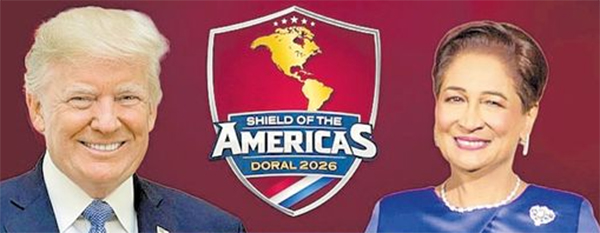



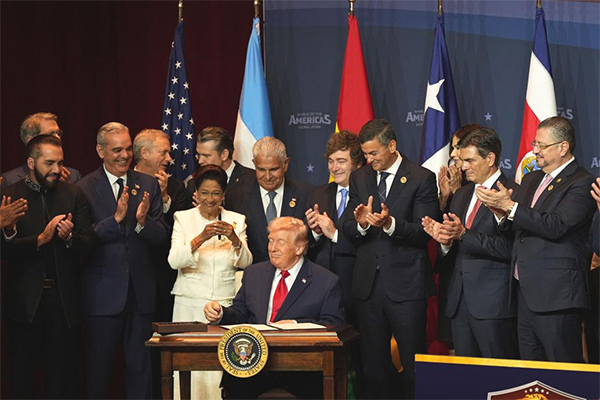
While the commentariat spent the week sniggering over protocol and gifted pens, Prime Minister Kamla Persad-Bissessar walked into a room few Caribbean leaders were invited to. Her appearance at Donald Trump’s Shield of the Americas summit in Doral wasn’t a photo op. It was a cold, calculated play for survival.
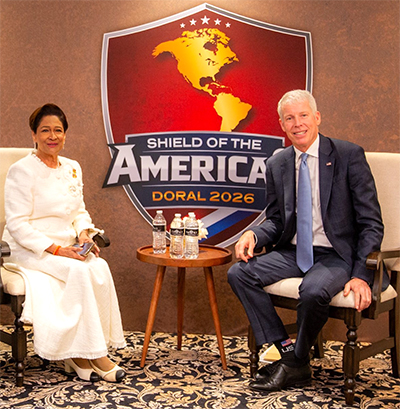
Trinidad and Tobago was one of only two CARICOM countries invited, and her government plainly stated the trip was meant to pursue energy and security opportunities through bilateral meetings with senior US officials and regional leaders.
That matters.
In diplomacy, access is not everything. But without access, everything else becomes harder.
Now let us be grown about this. Trump is not a neutral backdrop. The summit launched a new, heavily militarised anti-cartel coalition, and Trump’s own remarks carried the usual mix of swagger, provocation, and blunt-force theatre. Reasonable people can be uneasy about that. Reasonable people can also worry that a hardline security alliance, by itself, cannot solve the social roots of crime. Both things can be true at once.
But here is the other truth, and it is one too many of our tidy commentators hate to admit: when a small state is under pressure, sometimes leadership means entering an uncomfortable room because national interest lives there.
And Trinidad and Tobago is under pressure. Not imaginary pressure. Not “talk-show pressure.” Real pressure.
The country is dealing with persistent violent crime serious enough that the government declared another state of emergency this week, citing threats against law enforcement and escalating gang violence. At the same time, households are still feeling the pinch of food prices. The cost of feeding a family is still climbing, with the January 2026 CPI proving that grocery bills are only getting heavier.
Yes, the Ministry of Finance expanded the list of VAT-free food items in October 2025, but anybody buying groceries already knows the cost-of-living squeeze did not vanish because of a legal notice and a press release.
That is why Kamla’s attempt deserves more than the usual reflex sniggering over pens, protocol, and personality. The real value of the trip is not sentimental. It is strategic.
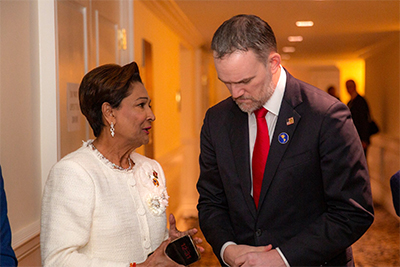
Engaging not only Trump and Marco Rubio, but also the US Trade Representative and the US Energy Secretary, meant this was no ornamental lime in Florida. It was an opening toward the three things Trinidad and Tobago most urgently needs from a superpower relationship right now: security cooperation, trade relevance, and energy leverage.
And on energy, let us stop pretending the stakes are small. The Dragon gas field is the beating heart of Trinidad and Tobago’s effort to feed its revenue-generating industries, from LNG to petrochemicals.
Energy Minister Dr. Roodal Moonilal hopes for production from Dragon in the fourth quarter of 2027 at about 350 million cubic feet per day. Shell aims to produce gas from Dragon in about three years and process it in Trinidad. Meanwhile, Atlantic LNG with 12 million tonnes per annum of capacity exported only around 9 million tonnes in 2025 because of gas shortages.
In plain Trinbagonian English: the country has infrastructure, demand, and earning potential, but not enough gas. Dragon is not a side note. Dragon is the economic argument.
Here is where the politics becomes more than symbolism. The United States matters enormously to whether Dragon moves. Washington granted authorization in October 2025 for Shell and Trinidad and Tobago to develop Dragon after an earlier licence was cancelled, yet Shell still requires US sanctions clearance to operate in Venezuela.
Then, this week, the US and Venezuela agreed to re-establish diplomatic and consular relations. Shell signed agreements with Venezuela, and the Dragon project is now set for development, with exports to Trinidad targeted for the third quarter of 2027.
So no, it is not fanciful to think a serious conversation with Washington could help Trinidad and Tobago’s energy future. It already has.
This is why Kamla deserves credit not blind praise, not worship, not the silly politics of sainthood, but credit. Because too often in this region, leaders mistake caution for wisdom and distance for dignity. They want the benefits of great-power influence without the discomfort of direct engagement. They want the deal without the difficult meeting. They want the harvest without walking into the field.
The PM deserves credit
Persad-Bissessar, whatever one’s party jersey, made the attempt. She showed up. She took the meeting. She placed Trinidad and Tobago in the conversation where decisions on sanctions, energy, security, and regional influence are actually being shaped. On that alone, she has done something more practical than many leaders who prefer to issue lofty statements from a safer distance.
But fairness requires the second half of the sentence. An attempt is not yet an achievement. The coalition’s militarised posture still raises legitimate questions. The Dragon project still depends on politics, licences, commercial execution, and regional stability.
Food prices will not fall tomorrow because a pen was gifted in Florida. A mother in Sangre Grande cannot stew the Doral Charter and serve it with rice.
She deserves credit for stepping into the arena. But the grace period ends there. The glamour of Doral will fade the moment the next gun is fired or the next plant shuts down. She got the meeting. Now, she must deliver the gas.
Still, this is not the day to sneer at the attempt. This is the day to recognise it for what it is: a calculated reach toward a better future in a country that cannot afford diplomatic laziness. In fragile times, a Prime Minister does not have the luxury of only taking pleasant meetings with polite people. Sometimes she has to sit across from power as it is, not as we wish it to be, and try to bend some of it homeward.
So yes, the pen is nice.
But the pipeline is better.
And if, behind those closed doors, Kamla Persad-Bissessar was pressing not merely for applause, but for security support, energy progress, and economic breathing room for Trinidad and Tobago, then she deserves kudos for doing what leadership is supposed to do: not posture, not preen, but pursue possibility where others might have preferred to pose from afar.
