


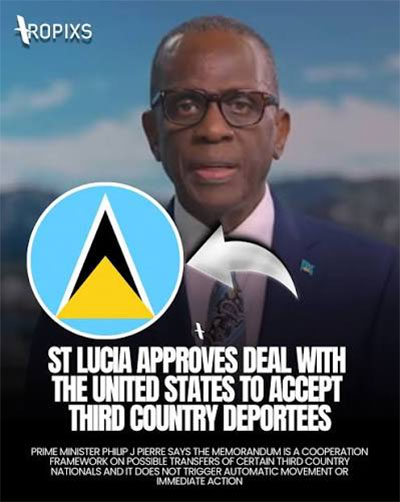



Dear Editor, Saint Lucia’s decision to sign a non-binding agreement that could allow the United States to send certain third-country deportees to the island should concern the entire Caribbean. The numbers may appear small, reportedly no more than ten people per quarter, and the St Lucian Government would retain the right to accept or reject each proposed transfer, but even so, this arrangement raises a much larger question: is the Caribbean slowly being positioned as a convenient destination for people whom powerful countries want to remove but cannot easily return home?
The Caribbean must not become America’s deportation waiting room.
The United States has every right to enforce its immigration laws. However, it should also accept responsibility for the human, legal and financial consequences of those policies. If American authorities order someone deported, why should a small Caribbean country be expected to receive that person when he or she is not its citizen and may have no family, cultural or historical connection to it?
St Lucia’s Government has offered some reassurance. The agreement is non-binding; each case would be examined separately, and people with known criminal records, apart from immigration violations, would generally be excluded. The Government is also negotiating financial assistance from the United States and has involved the International Organization for Migration.
These safeguards matter, but they do not answer the most basic question: how does accepting America’s third-country deportees benefit the people of St Lucia?
Citizens deserve more than assurances that the national interest will be protected. They need to know what the agreement actually requires. What legal status would these deportees have after arriving? Would they be detained, housed temporarily or allowed to work? How long could they remain? What would happen if their countries of origin refused to receive them? Would they be entitled to legal representation, healthcare or asylum protection? If they remained in St Lucia for years, would American financial support continue for years?
These are not minor administrative details. They determine whether a limited arrangement remains manageable or becomes an open-ended obligation placed on St Lucian taxpayers and public institutions.
We must also be honest about the imbalance between the two countries. St Lucia is a small developing state negotiating with the world’s most powerful country. The United States controls access to visas, security assistance, trade opportunities and development support. Even when an agreement is described as voluntary, Caribbean people are entitled to ask whether diplomatic or economic pressure influenced the negotiations.
The entire agreement should therefore be presented to St Lucia’s Parliament and made available to the public before anyone is transferred. Certain personal or security details may require protection, but the policy itself must not be hidden. Citizens should know what their government has promised, what the United States will pay and what responsibilities St Lucia may carry.
CARICOM should also address this matter collectively. The United States reportedly approached several Caribbean governments about similar cooperation. If each state negotiates alone and in private, Washington will naturally hold the stronger hand. A united Caribbean position would provide greater protection than a collection of separate arrangements negotiated by vulnerable states.
CARICOM should establish clear regional standards. No member should accept third-country deportees without parliamentary scrutiny, independent legal review, guaranteed financing, strict limits, proper security screening and enforceable human-rights protections. Every agreement should include a clear plan for eventual resettlement or repatriation so that no Caribbean country becomes responsible indefinitely.
This is not an argument against cooperation with the United States. Our countries share deep family, economic, cultural and security relationships. We must work together to combat human trafficking, organised crime and irregular migration, but friendship does not require the weaker partner to absorb the unresolved consequences of the stronger partner’s domestic policies.
We must also remember that deportees are human beings, not unwanted parcels to be redirected when the intended destination becomes inconvenient. Some may have lived in the United States for years. Others may fear persecution in their home countries. Sending them to an unfamiliar Caribbean Island could leave them stranded, isolated and trapped in legal uncertainty.
Caribbean history should make us especially cautious about powerful countries deciding where vulnerable people should be moved. Sovereignty is not demonstrated merely by signing an agreement. It is demonstrated by making decisions openly, freely and for the clear benefit of one’s people.
St Lucia may ultimately decide that a limited humanitarian programme reflects its national values. If so, the Government must explain that decision convincingly. What the region cannot permit is the quiet creation of a system in which Caribbean states become overflow spaces for American immigration enforcement.
The first arrangement may involve only a few people. The precedent, however, could extend across the region. Once the Caribbean signals that it is willing to receive third-country deportees, requests may grow, limits may expand and temporary arrangements may become permanent.
Our governments must establish firm boundaries now. The Caribbean can remain a good neighbour to the United States without becoming an extension of its deportation system.
By Hugo Maynard
